

• Oct 30, 2026
Healthy Relationships: Connection, Communication, and Boundaries
We all want to have healthy relationships, but they can be hard to navigate sometimes. Relationships work best with a balance of connection and communication, along with healthy boundaries.
This is true of any relationship, but especially the relationships we have with the children in our lives. Children need safe relationships with adults they can count on to help them navigate the relationships they’ll make with others in the future. Here’s how to show up for those kids, and why it matters.
Why Are Relationships So Important?
Our earliest relationships in life form a pattern for subsequent relationships. The basis of attachment theory is the idea that the relationship we form with our primary caregiver as an infant sets the tone for our ability to connect and relate to others throughout our whole lives.
Safe, predictable, nurturing and loving relationships, especially in the early years of childhood, are critical.
Here’s the good part: years and years of research has indicated that just one, that’s right, just one, attuned, predictable and safe relationship with an adult can make all the difference in a child’s long-term success. This positive relationship can be a parent, but could also be a teacher, a counselor, a coach, a faith leader… you!
Think back on the adults from your own childhood. Who were your safe, nurturing caring adults? Do you remember how they made you feel?
These relationships formed in childhood are at the core of our Model for Mental Health: Safe Relationships.
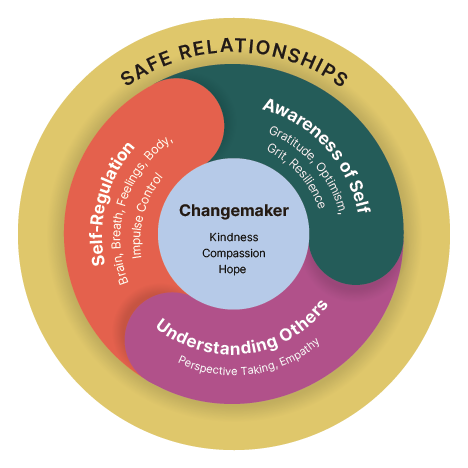
Now, let’s take a look at the components of safe relationships as a framework:
Safety: I know you won’t hurt me and that my needs are met
Predictability and Consistency: know what to expect when interacting with you
Trust: I feel safe sharing my thoughts and space with you
Curiosity: I know you seek to understand me and my needs
Attunement: I feel seen, heard and known
Empathy: I feel “felt” by you and my emotions feel safe
Check out our video series on safe relationships to learn more about how to build and sustain safe relationships with children, and how to intervene when trauma gets in the way.
Limit Setting 101
While establishing safe relationships for children is fundamental for their long-term mental health, setting boundaries is equally important. Here’s how to set limits with the children in your life while remaining kind and supportive at the same time.
Parents, teachers, anyone who works with children must sometimes set limits. But many also struggle with this task. How do you set firm limits while still being kind and supportive? What’s the line between appropriate limit setting and helicoptering? And what about the difference between limits and being laissez-faire?
To help us dive into this topic, we sat down with Diane Boehm, LPC, RPT, our Momentous School Mental Health Professional.
We discuss:
- What limits are
- Why it is important to set limits
- How to set effective limits
- Let’s jump in!
On what limits are
A limit is a boundary – often a verbal boundary – that is designed to create emotional, physical and/or relational safety for ourselves and others. So, for example, limits can be things like stopping a toddler from running into the street, setting a curfew for a teen, or deciding for yourself how you are going to let someone talk to you or treat you.
Some limits will be non-negotiable, like enforcing that a child wears a seatbelt, and others may need to be adjusted or agreed upon, like setting expectations for a child’s first cell phone. Limits provide the opportunity to function within a parameter that feels safe and comfortable, and allows others to feel the same way.
On why limits are important
I always think of the quote from author and researcher Brené Brown who says, “Clear is kind. Unclear is unkind.” All of us function best when we know clearly what is expected of us, what we can and cannot do, and how we should behave and act.
Limit setting with children – at home, at school, or in any other setting, helps them understand their clear boundaries that they must stay within. Doing so helps them know exactly what is expected of them and what will happen if they step out of those boundaries. This approach to limit setting helps prepare our children for the short-term and for the long-term as they learn to navigate the real world.
I think limit setting with children is sort of a lost art. Setting limits can feel uncomfortable. I’ve heard adults share that setting limits feels like it goes against a more social emotional approach to teaching or parenting. But I would argue that limit setting is a social emotional approach. It helps kids understand their social relationships and develops their emotional capacity.
Types of limits
I like to think of limits in a few categories. There are physical limits. These are the ones we use to make sure kids are physically safe. This might include safety precautions (seat belts, helmets, etc.) but also how we interact with others (hitting or other physical interactions).
There are behavioral limits. These include how we expect children to behave in different settings, how they participate in class, on the playground, at the dinner table, how they respond when someone asks them a question, what they do when they get frustrated, and so on.
Then there are relational limits. These have to do with how they interact with others (beyond the physical mentioned previously). How kids greet others, what do they do when they disagree with someone, and how they interact with peers, adults, family members, etc.
All these various types of limits help keep us and others safe, help us learn how to coexist with people who we may or may not like. They help protect us and be firm and kind with others.
Examples
A few examples might include:
- Our hands are not for hitting.
- Staying in your seat while the class goes to music is not an option.
- The language you are using is not kind and we do not use those words here
On when to set limits
Knowing when to set limits is tricky and requires us to pay attention. On one hand, we don’t want to be so rigid that there are limits around everything, leaving no room for creativity. On the other hand, we don’t want to be so laissez-faire that kids have no limits at all and don’t have a clear understanding of what is allowed and what is not. The right answer is somewhere in the middle… and it depends.
I’ll give an example. We have a wonderful teacher here at Momentous School who wanted to try something new in their classroom this year. The goal was to have the morning be a little more pick-and-choose, to counter the pretty structured schedule that students had for most of their time at school. The teacher set up a loose structure that allowed students to choose what to work on for a block of time at the start of the day. What the teacher discovered is that the students really struggled with ambiguity and needed more structure. This isn’t necessarily true of every group of kids – in fact, next year, the teacher might be able to pull this off with success depending on the students entering the class. But this particular group had a hard time, and the teacher had to go back and add more limits. The teacher ended up shortening the amount of time and putting clearer boundaries around what students could do during this time, and it ended up being very successful.
I share that to say, limits are dependent on the child(ren) in front of you, the environment, and many other factors. And they often have to be adapted with time.
On what to consider when setting limits
I think the most important piece is to figure out why you’re setting the limit. So, let’s say you’re setting a limit around what time your teen’s curfew should be. Why does it matter that they’re home at a certain time? Is it about making sure they are off the road before a certain time? Is it so that they’re home before you go to sleep? Is it about their need for sleep? Setting a curfew just to set one doesn’t necessarily make sense (and your kid will probably tell you that!) but if you think about the why first, you’re likely to set a limit that achieves your goal.
For younger kids, an example might be around mealtime. In my family, sitting together for dinner is important to us. So, when I ask my kid to stay at the table, even if they don’t feel like eating or don’t like what is being served, I know that limit I’ve set (stay at the table until dinner is over) is based on the idea that we’re all together. That keeps me from making the limit about something else, like for example, making my child eat a certain portion of their meal. This particular limit is about being together so whether they eat doesn’t need to be part of it.
After understanding the why behind the limit, you can start to set clear limits.
A model for limit setting
Garry Landreth’s acronym: ACT.
A: acknowledge the child’s feeling
C: Communicate the limit
T: Target the choice/alternatives
Let’s break that down with a few examples.
A child in a Pre-K classroom refuses to get in line. The teacher says, “I see you’re feeling frustrated, but it is time to get in line and go to music. You can choose to walk by yourself in line or walk with me.” Acknowledge the child’s feeling: “I see you’re feeling frustrated.” Communicate the limit: “It is time to get in line.” Target the choice: “You can walk by yourself or with me. Which one do you choose?”
A teenager wants to go to a party at the house of a friend their parents haven’t met, and the parents don’t feel comfortable with it. The parent says, “I know you’re really upset with me, and you are worried you will be left out. I can’t let you go to this party tonight. We can do something fun together or you can hang out with a friend we do know. A: “I know you’re upset”, C: “You can’t go to the party”, T: “You can choose…”
And of course, there are times when limits are just quick. A kid talking during instruction or interrupting someone can just be handled with a simple, “I know you have something to share, but right now, I am speaking.”
On kids pushing back
When an adult sets a limit, a child may not like it, and may even challenge it. This goes back to understanding the why behind the limit. If a parent sets a 9:00 curfew and a child says, “All my friends have a midnight curfew,” it might be time to compromise. Remembering the why can help an adult decide what they’re willing to give, and what firm line they’re going to hold. If the parent wants the child home before they go to bed to make sure they make it back safely, they can say, “I hear what you’re saying. I like to be in bed by 10:30 and if you’re coming home after that, I won’t be able to make sure you’re home safely. How about we try a 10:00 curfew and see how that goes?”
And sometimes you can’t negotiate. If safety or even logistics get in the way, compromise may not be possible. This is when it’s important to communicate the why behind the limit, and then hold the line even if a child is upset about it.
On kind limits
At the end of the day, we can set limits with kindness. We can get down on a child’s level, use a calm tone of voice, say our limits with warmth, communicate that we care about the child and that is why we are setting a limit. Limits can be uncomfortable, but they don’t have to be scary! The more we practice, the easier it gets.
For a quick sheet on using the ACT model in schools, click here.
When to Say Yes!
Yes, limit setting is important. But that doesn’t mean we never say yes to our kids.
Sometimes we get caught in a cycle of saying “no” to kids.
No, we can’t play that right now. I’m trying to respond to these emails.
No, you can’t wear that orange shirt with those green pants.
No, you can’t sit on the couch to do your math work. You need to stay at your desk.
Of course, sometimes the right answer is no. But sometimes we can break from this habit and try saying yes.
Sure, I will write back to these emails after you go to bed. Let’s play!
Sure, go ahead and wear whatever you would like. You’re a kid; it doesn’t really matter.
Sure, if you think sitting on the couch will help you focus, let’s give it a shot and see how it works!
If you just give “yes” a more prominent role in your vocabulary, who knows what might come of it.
In the end, it’s all about setting healthy boundaries. This helps us know when to say yes to things, and when it’s okay to say no. But in order to have healthy boundaries for our kids, we have to know how to set them ourselves.
How to Set Healthy Boundaries
Boundaries, boundaries, boundaries. This seems to be the big topic of conversation these days. We all know we need boundaries – but how do you even set them?
Let’s talk about how teachers can set healthy boundaries – not just for their classroom, but also for themselves.
What are boundaries?
Boundaries are limits that we set to ensure we are emotionally and mentally safe. Boundaries can be rigid, loose, or… well, nonexistent at times.
Teachers tend to first think about boundaries in the boundaries we set with students, like sticking to the rules, expectations, daily schedule, and student-teacher relationships. These boundaries are so important in building classroom culture and managing behavior.
However, it is also important to think about your own emotional and mental boundaries.
As educators and care givers, we take our work to heart and deeply care about our colleagues, students, and families we work with. Sometimes that caring and constant cycle of being needed can be wearing. It can be difficult for recognize that the absence of boundaries, when that happens, can be taxing to our mental health and wellbeing.
Here are six ideas to think about that can be helpful as you set, refine, or create boundaries.
1. Maintain a predictable work schedule.
Set boundaries around your workday by establishing (and communicating) your office hours. What time are you available to respond to calls or emails, and when are you not? Designate work-free times, or a specific curfew after which time your work computer is shut off, even if there is work left to do.
2. Ask yourself, “Is this something that can wait until later?”
We can often get swept up in completing to-do lists or capitalizing on any minute of free time that we keep going even when there’s an opportunity to stop. If you find yourself using every free second to finish tasks, you’re likely not taking a moment to breathe, refill your water bottle, or just have a moment of quiet. If something can wait, let it wait.
3. Lean on your team and ask for help when you need it.
We aren’t meant to solve everything ourselves! Think how you would respond if a friend or colleague asked for your help. You’d probably be happy to support them! We often think that asking others for help is a burden. You may be surprised to find that people are happy to help when given the opportunity.
4. Take a technology break.
There’s a reason we give kids breaks from technology! We all know how it feels to come up for air after staring at a screen for too long. Technology breaks are an important boundary that can help us perform better throughout the day. Even better than occasional technology breaks? Scheduled screen-free time.
5. Take care of yourself.
You can’t give what you don’t have. Do yourself a favor by making a schedule for self-care, and then honoring it. Healthy boundary setting looks like: “Sorry I am not available at that time. It is my scheduled exercise hour.”
6. Don’t say yes when you really mean no.
If you ever have that icky feeling in your gut that you really, really can’t do something you promised to do, or you really, really don’t want to go through with something… listen to it. But even better, try to avoid it. You can do this by listening to yourself (and your body) when given opportunities. Deep down, you know when you really want to say no. So don’t say yes.
Ultimately, it is up to us to keep these boundaries so that we can continue to show up as resilient and compassionate parents, caregivers and educators.