
Resource • Nov 23, 2026
What Happens in the Brain During Stress
Understanding the Science of Stress
The truth is, A physical, mental, or emotional factor that causes bodily or mental tension. (APA) is all around us. We often bounce in and out of various states of stress throughout the day – or throughout the hour. So, what should we know about this experience of stress? What happens in our The organ located in the head that controls thoughts, memory, emotions, touch, motor skills, vision, breathing, temperature, and every process that regulates the body. (APA) and body when we’re stressed? How do we best navigate it and manage it? Let’s take a deep dive into the science of stress.
What is stress?
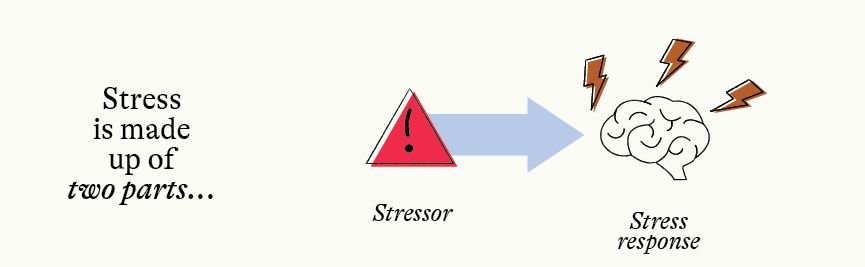
When talking about stress, it can be helpful to break it down into two parts: a stressor and a stress response.
A stressor is any event that triggers a stress response in the body. Anything can be a stressor! A big presentation, a sick child, or a frustrating morning commute can all be considered a stressor and can all trigger a response in the body.
A stress response is the way your body reacts to the stressor. Common stress responses in the body include sweaty palms, increased heart rate or rapid breathing. A stress response is your body’s signal that you need to change or adapt in order to manage the stressor.
Different Types of Stress
It is important to know that stress is not all bad.
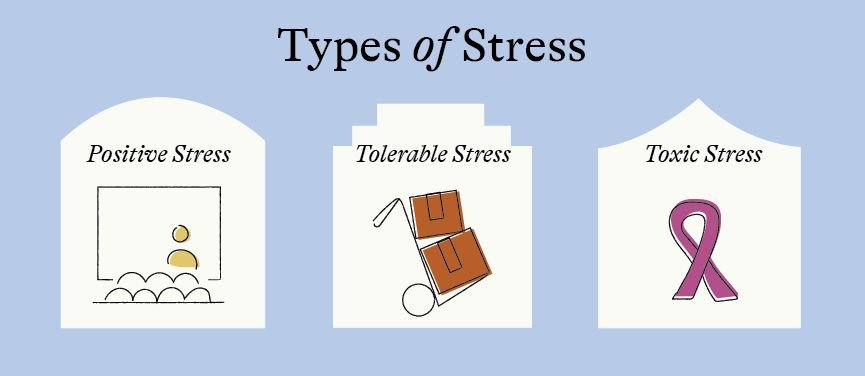
In fact, the truth is – most stress is good for us! We can categorize stress into three groups: positive, tolerable and toxic.
Positive stress is the stress that we get when we’re working on achieving a goal, or stress that motivates us to take a healthy risk. Think of that pre-exam stress or that nervous energy before walking on stage in front of a group.
Tolerable stress is serious, but temporary stress that is buffered by safe and supportive relationships. This might be something like getting a new job, moving to a new city or caretaking for an ill family member.
Toxic stress is strong, frequent or prolonged adversity without a buffering of safety and supportive relationships. Toxic stress might be getting evicted, working with a dangerous boss or managing a chronic illness.
You’ll see that, while we’ve given a few examples, we aren’t providing a comprehensive list of what stressors fall in each category. That’s because it would be impossible! What is tolerable for one person may be toxic for another. It is not the stressor that determines the severity of the stress. How a body responds to stress depends on a variety of internal and external resources.
Internal resources are things like:
- Resiliency factors
- Physical and mental health
External resources are things like:
- Friends, family or other community
- Access to quality mental health care
- Socioeconomic status and other privileges
The more resources available to a person, the better able they are to handle stressors and keep stress from becoming toxic. Of course, these resources are not available equally to all people, and this helps explain why some individuals and some communities face greater amounts of stress than others.
What Happens in our Brain and Body
To better understand how stress and the body are connected, we need to understand a few simple concepts. Let’s start with the brain.
You brain is your central processing network. It guides everything that you do: your body’s movements, your decision making, and your emotions. There are, of course, countless things we could say about the brain. But let’s keep it simple and focus on just a few.
There are four main parts of the brain we want to explore: the amygdala, the hippocampus, the prefrontal cortex, and the hypothalamus.
The hippocampus processes and stores information and memories. It’s your brain’s filing cabinet.
The prefrontal cortex is the logical, reasoning part of the brain. Think of this as Brain HQ.
The amygdala is the emotional center of the brain. It regulates emotions and stress.
The hypothalamus is the relay station between the brain and the body. It receives and sends signals in the form of neurotransmitters.
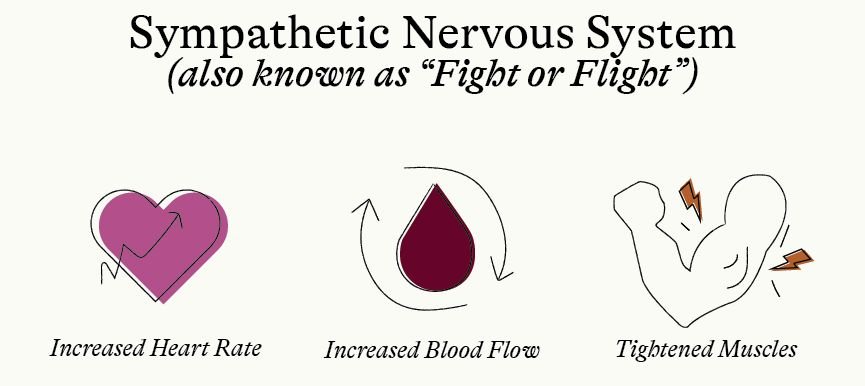
The body has something called the autonomic The network of nerve cells and fibers that transmits nerve impulses between parts of the body. (APA), which regulates involuntary body functions. Within this system, there is the sympathetic nervous system and the parasympathetic nervous system. Both systems are involuntary and happen without reason or logic, but understanding them helps make sense of our brain and body’s reactions.
The sympathetic nervous system is often called the fight or flight response. It is activated when we face a threat and causes a physical involuntary response, such as increased heart rate and blood flow, and tightening of muscles. When this system is activated, the parasympathetic nervous system is not functioning at full capacity.
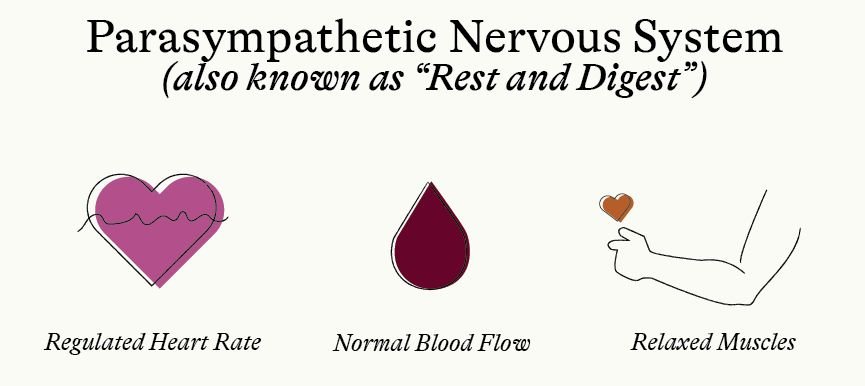
The parasympathetic nervous system is often called the rest and digest system. It affects the same body functions as the sympathetic nervous system, but in a different way. It works to slow down certain responses, allowing the body to rest and repair.
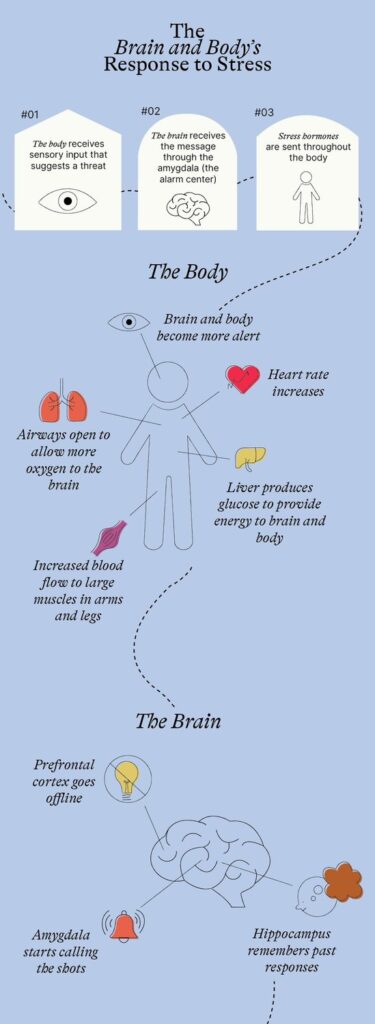
So here’s how it works. The body receives sensory input (it sees something, feels something, etc.) that suggests there is a threat. This message is immediately sent to the brain, where it first lands with the amygdala. (The prefrontal cortex – the reason and logic part of the brain – also receives sensory input. However, the amygdala, in the center of the brain, gets the message first. This means it’s not possible to stop the amygdala from initiating a stress response when it senses a threat… even if the prefrontal cortex would be able to identify it, make sense of it, or decide it’s not a threat at all.)
When the amygdala receives the message that there is a possible threat, it sounds the alarm. It signals the hypothalamus to release stress hormones that send a message to the adrenal gland letting it know that it’s go time. The adrenal gland, located at the top of the kidneys, releases hormones called epinephrine (adrenaline) and norepinephrine into the blood stream. It’s at this point that the stress response becomes a full-body response.
Epinephrine increases the heart rate, sending blood to the large muscles in the arms and legs. It also opens airways, allowing for more oxygen to flow into the brain. Additionally, epinephrine increases blood sugar levels which leads the liver to produce more glucose to provide energy to the brain and body. At the same time, norepinephrine causes increased alertness, arousal and attention and also causes blood vessels to constrict, maintaining the body’s blood pressure. Think of it like this: the brain determines something is dangerous and gives the body all the muscle power, oxygen and energy it needs to tackle the threat. Now, while all of this is going on in the body, there are other things happening in the brain. Once the amygdala senses a threat, it takes over. This means that the prefrontal cortex goes ‘offline’ and the amygdala and hippocampus start a conversation about how to respond to the threat. The hippocampus jumps in, providing memories about previous stress responses. These memories will help determine if the correct response is fight, flight or freeze.
Everything we just described is what happens in the immediate seconds following a determined threat. For example, your boss unexpectedly asks you to stop by to chat about something. If this is a normal routine and doesn’t cause any stress, the brain and body will continue as normal. But if something about this registers as a threat, perhaps previous experience with this boss, or bosses in general, the brain and body may go through the process described above before you can even say, “Sure, I’ll be right there.”
Then what happens?
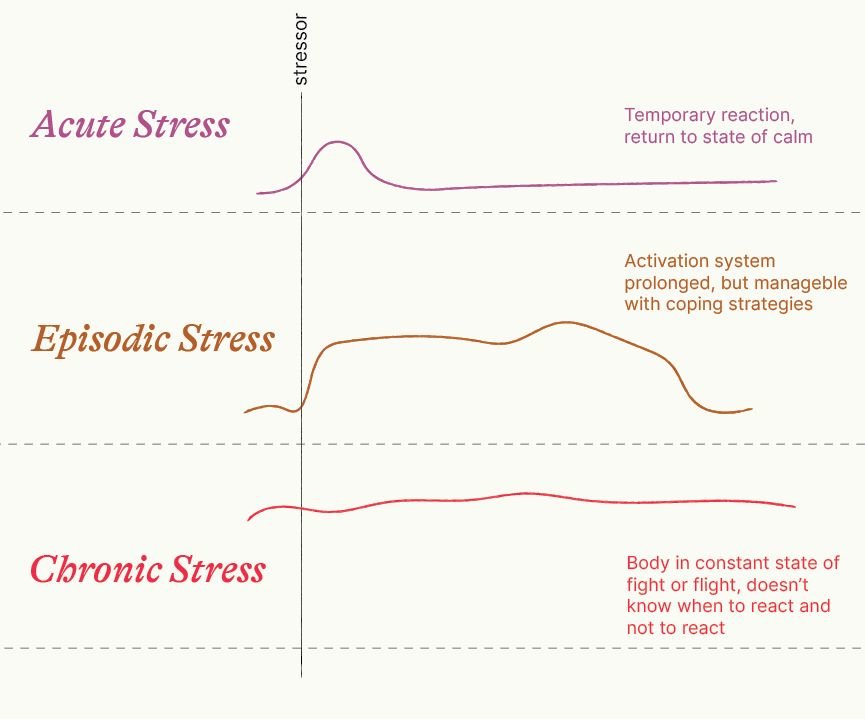
This is where we revisit the types of stress. The body is designed to manage positive stress. It recognizes that something is happening, but also determines that it is safe. The body will have a temporary reaction, as described above, and will return to a state of calm pretty easily or quickly. Deep breathing, a brief walk or a phone call with a trusted loved one can send the brain the message that it is safe.
Tolerable stress is more prolonged and lasts longer than just one instant. In this situation, the activation system is prolonged, and it doesn’t return to a state of calm as easily. This type of stress may pile on top of itself, so just when one stressor is getting managed, another thing comes along. But what keeps this stress tolerable are coping strategies that activate the parasympathetic nervous system that can help manage it. It takes more effort to reduce tolerable stress, because the system has been activated for longer. This means that it is not as effective at determining whether something is a threat and may start to identify more and more things as stressors.
With toxic stress, the stressors don’t stop or there is no end in sight. In this case, the brain is on such high alert that it can start to lie to the body and tell the body that it is not safe, even if it is. The stress response in this case doesn’t know when to react and when not to react. The body can be in a constant state of fight or flight, meaning the sympathetic nervous system stays activated, and anything from a loud noise to someone brushing up against you in passing can trigger a stress response. This stress is the most difficult to manage because it requires not only the lessening of stressors, but also the regulation of the stress response system in the body to bring it back to a state of calm.
More Stress Hormones
We can’t talk about stress in the body without talking about a few other hormones. We’ve already discussed adrenaline (epinephrine) and norepinephrine, above. But there are quite a few hormones at play in the stress response system!
Hormones are chemical messengers for the body. They are produced by the endocrine system (in the body) and travel via the blood stream. We are made up of over 50 different hormones that control our body’s biological processes. For the purposes of stress, we will focus on a few key hormones.
Cortisol is nicknamed “the stress hormone”. It’s an important part of the body’s built-in alarm system. During moments of stress, cortisol is released in the body, which does a number of things, including prompting the liver to produce glucose, which helps the brain with alertness and attention. It also signals to the non-emergency functions of the body to take a back seat – things like digestion and growth.
Oxytocin is sometimes known as the “love hormone” because it spikes when we have positive social interactions with those around us. What does this have to do with stress? Research shows that oxytocin can dampen the fear response (that old fight-or-flight instinct), essentially making you better able to face a stressor. But not only that. Oxytocin is released as part of the stress response system to encourage you to connect with other people. This is called the “tend and befriend” response. It is one way that people manage stress, by connecting with people and communities that are important to them.
Our brains are wired for acute stress, followed by a recovery period. We are not wired for stressor after stressor after stressor. This is why chronic stress is difficult for the brain and body to manage – they weren’t built for the job!
Allostatic Load
Chronic stress can lead to allostatic load, also known as “wear and tear” on the body as a result of stress.
The body has regulation systems in place to keep it healthy for survival. Homeostasis is a steady state; it is when the body’s internal, physical and chemical conditions are regulated. This is our body at optimal functioning – body temperature, blood sugar levels, energy, hormones and more are constantly adjusted to respond to changes both inside and outside the body to keep them at a normal level.
Allostasis is the body’s way to achieve stability through change. It is how the body works to get back to a state of homeostasis. Rather than just responding to the environment, allostasis is predictive, meaning it is flexible and anticipates the body’s needs before they arise, budgeting resources accordingly and adapting promptly to meet the needs. For example, a bear preparing to hibernate for winter will build up fat deposits in the body. This is an example of an allostatic state.
You can imagine that it takes considerable energy to predict future outcomes. In a situation where upcoming stressors are predictable, the brain and body can manage this fairly smoothly. But at times where there is uncertainty or the stress is not resolved, the situation might become chronic and result in allostatic overload.
Situations that may lead to allostatic overload include:
- Exposure to frequent stressors or chronic stress
- The inability to adapt to repeated stressors
- The inability to shut off the stress response after the stressor is gone
- The body’s allostatic response doesn’t meet the need of the stressor.
Allostatic overload often results in difficulty sleeping, lack of energy, generalized An emotion characterized by feelings of tension, worried thoughts, and physical changes like increased blood pressure. (APA), social impairment or generally feeling overwhelmed with the demands of life.
Long Term Effects of Stress
We have talked about the immediate impact of stress on the brain and body. But what happens in the long term?
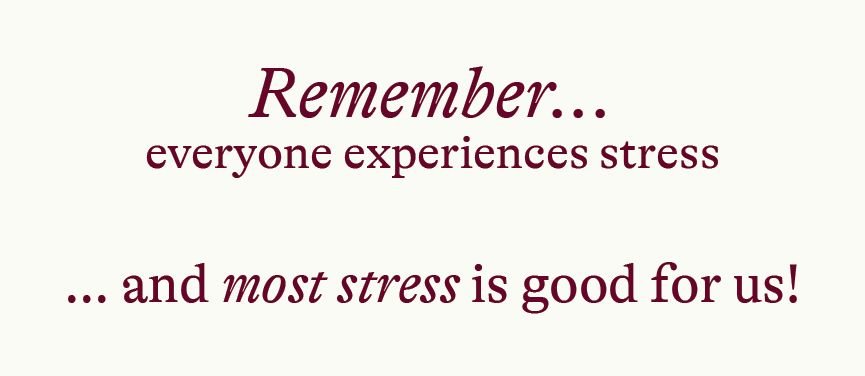
It is important to remember that everyone experiences stress – and that most stress is good for us! When our body experiences positive and tolerable acute stress, it builds the capacity for future stress responses. In essence, the hippocampus stores memories that help us later recall successful responses for the next incident.
And remember, stress is made up of two parts: stressors and stress responses. Stressors are an inevitable part of life. There’s no way to make it through life – or even just a day – without encountering stressful moments. Our stress responses, on the other hand, can be positive. They can help us navigate life and give us valuable tools for managing what comes our way.
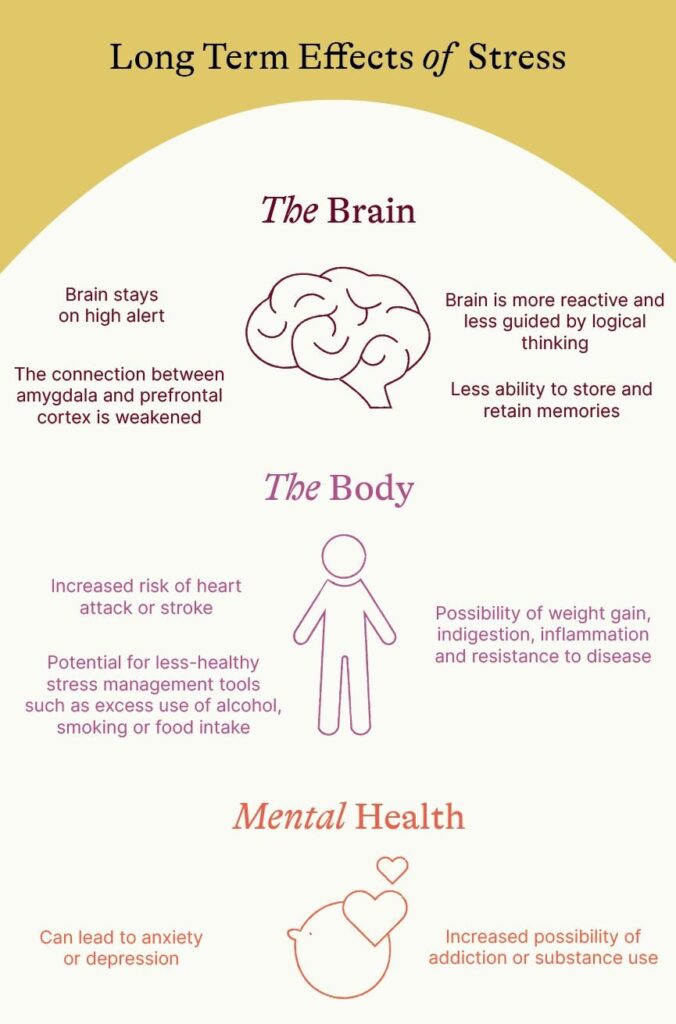
However, it is not surprising that when we have too many stressors and/or unhealthy or insufficient stress response systems, we can encounter damaging long-term effects. Chronic stress can lead to serious health problems, such as heart disease, A mood disorder that involves extreme sadness or despair and lasts longer than a few days. (APA), and anxiety disorders. It can also suppress the immune system, making it harder for the body to fight off infections and diseases. Chronic stress can impact the following areas:
The Brain
Too much stress can put the brain on high alert, and as a result, the connection between the amygdala, hippocampus and prefrontal cortex can become weakened. When this happens, the prefrontal cortex is less able to do its job (logic and reason), meaning the brain may continue to be more reactive and less guided by logical thinking.
Excess levels of cortisol, the stress hormone, can affect the hippocampus’s ability to produce new brain cells and repair damaged cells. The result? It can diminish the brain’s ability to learn and retain memories. Read on below for a deeper look into what happens when our brain is under stress.
The Body
Most people are aware of a link between stress and the heart. We know that heart attacks and heart disease are often linked to higher levels of stress. What’s the science to this? When the heart experiences repeated surges of adrenaline (epinephrine), it can damage the lining of the blood vessels. This can increase the risk of heart attack, stroke and hypertension.
Another reason these two are linked is because some people experiencing stress rely on less-healthy stress management tools, such as excess use of alcohol, smoking or food intake, which can also lead to heart problems.
Stress can also have other physical responses, such as weight gain, indigestion, inflammation, and resistance to disease.
A state of well-being in which an individual realizes their own abilities, can cope with normal stresses of life, can work productively, and is able to contribute to their community. (WHO)
Allostatic overload or chronic stress can also affect a person’s mental health. It’s not hard to imagine that when someone is in the dark tunnel of chronic stress and can’t see the light at the end, it can take a toll on emotional wellbeing. Prolonged stress can lead to anxiety, depression, addiction, or substance use. It can be difficult to untangle these experiences. Does stress cause an anxiety disorder, or does an anxiety disorder cause stress? Is a person’s substance use an unhealthy coping strategy for a stressor, or is the substance use creating or extending the stress response? While the science is not definitive, there is evidence in the field of mental health to show that chronic stress can cause or contribute to other mental health challenges.
But don’t worry, it’s not all bad! There are strategies we can use to help us deal with stress. We can also shift our thinking when it comes to stress. Psychologist Kelly McGonigal talks more about this perspective shift in her TED Talk, “How to Make Stress Your Friend.”
Stress and the Brain
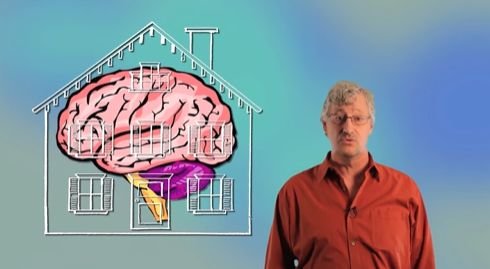
Now we all know that too much stress isn’t healthy for us. In this short video, you’ll see exactly what stress does to our brain and how it affects young children.
Watch as Director of Child and Adolescent Therapy, Fred Lines and clinician Frankie Perez break it down in simple terms. What does stress do to the brain? Spills and sirens and bears, oh my!
Let’s Talk More About Fight, Flight and Freeze
In the video, our experts introduced the conceof Fight, Flight and Freeze. The “fight, flight or freeze” response describes our automatic stress response system. When faced with a stressor, most people respond with one of these methods – they fight back against the stress, they leave, or they freeze in place.
When we are faced with stress, we are impacted in primarily two places – the brain and the body. We can sometimes identify how one or the other responds to stress, but we don’t often take a holistic view. For example, we may know that when we’re stressed, we have stomachaches (body) or we can’t think clearly (brain) but we may not be aware of how it all ties together. Very briefly, we’d like to break each of these stress responses down into how they show up in the brain and the body.
One quick note – it is important to remember that our body responds to stressors, both real and perceived. That means that the body may jump into fight, flight or freeze even if the stressor isn’t a real threat. It’s important to pay attention to our body when we notice these stress responses in us, even if we’re surprised by what caused them. Sometimes it’s easy to guess why we have a stress response, and sometimes it can come out of nowhere. Understanding our body’s response to stress can help us better manage these responses in the future.
FIGHT
The brain:
Of course, these stress responses are unconscious reactions, not well thought out, measured reactions. But in fight mode, it’s as if the brain is saying, “If I attack first, this threat can’t attack me.” Or, “If I attack, I can weaken this threat’s attacks at me.”
The body:
In fight mode, the body may experience a rush of adrenaline, and/or tightened fists or joints, as though preparing to physically fight. The body may have digestive issues or may have a trembling or shaking sensation. A person in fight mode may have outbursts, use physical violence or aggressive.
FLIGHT
The brain:
The brain in fight mode is signaling to the body that there is danger – it is like sounding an alarm, alerting the body to escape and flee to safety. When the alarm is activated, other regions of the brain, those required for logical thinking and problem solving, don’t function as well.
The body:
The body in flight mode is focused on getting out of there – so the body may respond by leaving the situation, walking or running away, or hiding or retreating.
FREEZE
The brain:
In freeze mode, the brain is so overwhelmed by the threat that it shuts down as a protective measure. In this stress response, many of the normal functions of the brain are not available.
The body:
The body may respond to stress by becoming disengaged or numb. This can look like “playing dead” or being unresponsive. Physically, the body’s heart rate can decrease to sub-optimal levels.
It is important to note that the brain doesn’t have time to make a conscious decision about which stress response is most appropriate for the situation. It simply responds instantly and automatically. It is the brain’s way of protecting the body from danger!
So what can we do with this information?
Pay attention to your body’s response to stress. How do you typically respond? Did any of the above ring true for you? Do you have more of one type of response than another?
What triggers stress responses in you?
What helps soothe you and bring you back to a more regulated state?
The brain and body connection is very powerful. When we are aware of how our body is responding to our environment, we can better care for ourselves, both physically and mentally.
How Men and Women Respond to Stress
Imagine that you’re walking on a nice tree-lined path on a sunny day. All of a sudden, a bear pops out from behind a tree. What do you do? Fortunately, the brain kicks in and our body responds to these types of threats automatically. If we had to stop and think, “What should I do now?” we’d probably be eaten before we came up with a good plan.
For years, the way the body responds to intense stress has been referred to as “fight or flight”, or more recently, “fight, flight or freeze.” Depending on a person’s biology and past experiences, as well as the nature of the threat, a person will typically respond in one of these ways. They’ll fight the bear, run away from the bear, or stand frozen in fear.
But there’s a twist – despite how common this concept is, the truth is that the studies that identified these as common stress responses were primarily done on men. So while “fight, flight or freeze” is a natural human biological stress response, it’s not necessarily true for everyone.
Women often have a different stress response, which researchers call “tend and befriend”. Think back to the tree-lined path. This time when the bear pops out, imagine that you’re holding a baby. Now what do you do? Your choices are different when you have offspring to protect.
This is the general concept behind “tend and befriend”. Historically, women have had more of a role in the caretaking of young children. Even though today many men and women share these responsibilities, or many women work outside the home and are not the sole caretaker for young children, female stress responses have evolved based on successful stress responses. Essentially, responses to threat that were successfully passed on would have been those that protected both self and offspring.
So, what is “tend and befriend”? First, let’s talk about “tend”. The idea behind “tend” is that women are more likely to nurture during time of stress. An interesting study by Repetti showed that fathers who had a stressful workday were more likely to be either irritable or less responsive with their children at the end of the day. On the other hand, mothers who had a stressful workday were more likely to be more responsive, nurturing and connected with their children. On days when women reported their highest level of stress at work, children reported the most connection with their mothers at home. In short, the “tend” response indicates that women sometimes react to stress by being more nurturing or caring than at other times.
What about “befriend”? Think back to the bear jumping out at you. If the bear sees one tiny little person, it might attack. But if 100 eyes are staring back at it, the bear may back down. If a predator thinks that others might come to the prey’s rescue, he may be reluctant to attack. That’s the idea behind the concept of “befriend”. Of course, we’re not talking about bears. But the idea is that the more people who surround us, the more likely we are to manage the stressor.
Research shows that under conditions of stress, women are substantially more likely to affiliate with others than men are. The research by Taylor et al calls this “one of the most robust gender differences in adult human behavior.” Essentially, women are more likely to connect with others (often other females) to survive periods of stress. The same is true for young women; adolescent girls lean to their support networks at a higher rate than boys do.
Much of what we have learned about managing stress is based on studies conducted primarily on men. As a result, researchers have missed opportunities to understand the biological stress responses of women.
Implications of this research are huge. Think about the higher rates of acts of aggression committed by men. Could this be linked to a fight, flight or freeze stress response? What about the way some women stay in dangerous or violent relationships? Could this fall under the category of tend and befriend?
Understanding how men and women differ in their stress responses can help us as we interact with both genders. Women and girls may need additional support from peers when faced with a difficult situation, while men and boys may need resources to calm down.
For more information about this stress response, read Dr. Taylor’s APA Journal article or her book, The Tending Instinct.
Children and Stress
Stress is not a phenomenon unique to adults. Sure, kids don’t have difficult co-workers, stressful morning commutes or financial worries. But there are plenty of stressors that affect children of all ages. As children grow up, they learn new coping mechanisms and discover new ways to respond to stress. What causes stress in children?
What do kids have to be stressed about? They don’t pay bills or have any real responsibility! The truth is, plenty. Even very young children experience stress.
Children are often very in tune with their environment. Even if they aren’t talking about what’s going on around them, they are experiencing it emotionally. Anything that is bubbling up in a child’s environment can cause stress for that child. Sometimes what causes stress is not necessarily something negative – just something different. But children pick up emotionally on what is happening around them and even positive experiences and changes can cause a stress response.
Here are a few examples of things that may cause stress for a child:
- Moving to a new home
- Welcoming a new member into the family – sibling, elderly adult, etc.
- Starting at a new school, moving to a new grade or getting a new teacher mid-year
- Dealing with a peer conflict
- Something happening in the news
- Changes in the family routine, such as a parent having a new schedule
- Changes in the family structure, such as divorce, remarriage, or introduction of step siblings
- Loss or illness of a loved one
- Increased pressure from school or extracurricular activities
- Uncertainty, not knowing what to expect about something coming up
- Financial or other family hardship
- Discrimination
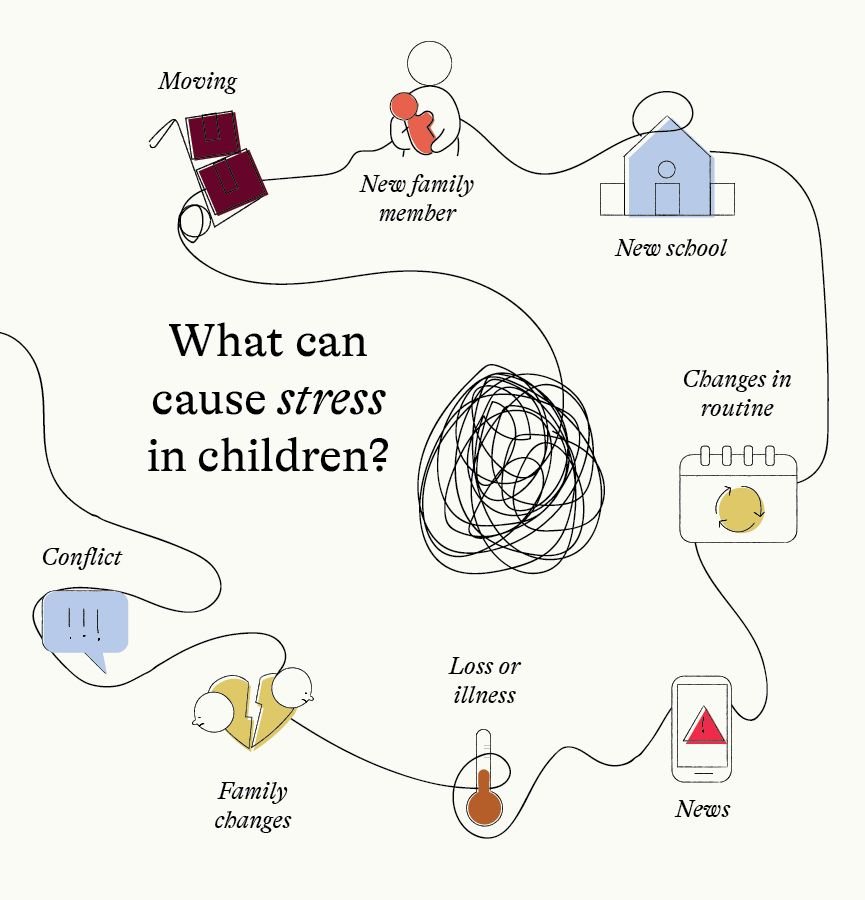
This is a non-exhaustive list, because the reality is: anything can be a stressor. Stress responses happen in the body, not because the logical brain has weighed the pros and cons of a situation and determined it to be a threat, but because the brain works instinctively and involuntarily to respond to stressors in order to protect us from harm. However, understanding the various types of experiences and incidents that can cause stress in children can help adults get to the root of a child’s behavior. When in doubt – explore their environment and look for any signs that something is different or difficult.
Stress in Young Children
In young children – babies, toddlers and early elementary age children – stress often shows up in two different ways.
The first is called “externalizing”. This is when a child’s behavior turns outward. Externalizing behaviors as a result of stress in young children could include:
- More active, more “all over the place”, seemingly more energy
- On high alert, running around, less calm
- Trouble sleeping, unable to fall asleep easily or waking during the night, waking up tired in the morning
- Changes in appetite – hungry more often or not as hungry as usual
- More agitated, snapping at people or fussier more often than usual
The other way that young children may respond is called “internalizing”. This is when a child’s behavior turns inward. This might look like:
- Tired or sleepy very often
- Physical complaints, headaches, stomach aches
- Wanting to spend more time alone, not connecting with others
- Not as focused, unable to do homework or other tasks that require concentration
- Not interested in playing with friends
- Picking behaviors, biting nails, picking at skin or pulling hair
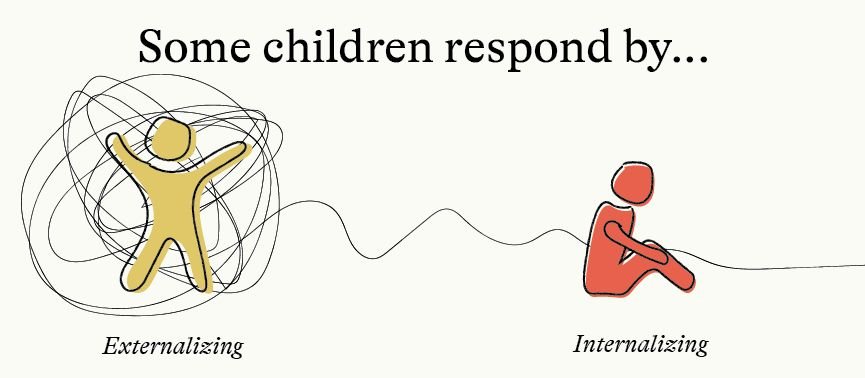
Some children may only externalize or internalize, but some waver back and forth between the two.
It is important to note that adults often have stress management skills, and so we can often experience a stressor longer before we begin to notice changes or exhibit behavior. Children, especially young children, don’t have these skills yet, so behavior typically bubbles up quickly. In fact, children can often be the first clue that something needs attention! They can serve as an alarm that there is a stressor in the environment.
Stress in Older Children
As children age to middle and high school, they begin to navigate stress a little differently. Most children this age are more naturally drawn to their peers than their adult family members. This is normal! It means that children may not be as likely to tell an adult what they are experiencing and how they’re managing it. But here are a few clues that an older child is experiencing stress:
- Changes in a child’s sleep schedule
- Physiological changes such as digestion issues or headaches
- Changes in diet and/or exercise
- Isolation or withdrawal from family or friends
- Increased risk-taking behaviors
Older children may also be experiencing stress for something they are embarrassed about or don’t want to share. For example, they may have done poorly on a test because they didn’t study, or they may be worried about a friend. Older children won’t always talk, but stress usually shows up in the body if we are paying attention.
Anxiety vs. Stress
Stress is made up of two components: a stressor and a stress response. The stress cycle is designed to work like this: stressor occurs – body reacts – stressor goes away – body returns to state of calm.
For example: big test – palms are sweaty, muscles are tense – test is over – body is fine.
But what happens when it doesn’t quite work that way?
Sometimes a child is experiencing stress, but sometimes it is bigger than that. Anxiety is a clinical term that describes worry or anticipation that is difficult to control and lasts for an extended period of time. One does not need a clinical diagnosis to have the symptoms of anxiety, but when anxiety begins to affect a person’s life and create challenges that prevent them from doing what they want or need to do, a diagnosis with support from a professional may be helpful.
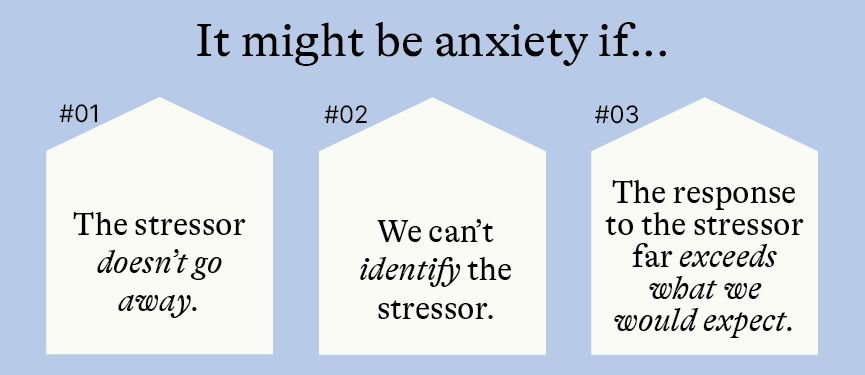
Here are a few key ways to determine if a child’s stress could be anxiety.
The stressor doesn’t go away. If a child faces chronic stress, they may be in a heightened state of alert, and the body may not get the message to return to a state of calm.
We can’t identify the stressor. If a child has stress response symptoms, but doesn’t know what is causing them, it doesn’t mean there isn’t a stressor. It’s possible the child (and the adults in the child’s life) can’t see something is causing stress. But it also could mean that there’s not one single stressor, and that in fact, the child is experiencing a form of anxiety.
The response to the stressor far exceeds what we would expect. If symptoms are interfering with a child’s life, getting in the way of what a child needs to or wants to do, the stress may be anxiety.
Anxiety causes most people to avoid the thing(s) that make them anxious. For example, for some, social interactions may be stressful. As a consequence, a child may choose to retreat or may find making friends very hard. But with anxiety, the fear or discomfort can grow and begin to impact many interactions, leading the person to feel anxious. What then? The reaction is often to try to avoid, avoid, avoid – avoid all stressors or situations which might be stressful. This can lead to challenges meeting responsibilities and interacting with peers or others outside the home. Of course, avoiding everything is impossible. So when a person is pushed to do something that causes anxiety, it can sometimes come out as aggression, distraction, or physical complaints.
How to Help Children with Stress
The best way we can help children manage their stress is by giving them the tools they need to navigate it. This will set them up for a lifetime of success. After all, the stressors will keep coming throughout their lives! How successful they are at managing it will depend on their arsenal of tools and their past experiences.
Here are five strategies to help children best navigate stress.
1. Have the conversation
2. Use The practice of being aware and present in the moment, and accepting one's feelings, thoughts, and bodily sensations without judgment. (APA) and sensory practices
3. Take care of the body
4. Let them struggle and even fail
5. Put systems in place, when you can

Have the conversation.
Giving children a language for what they are experiencing helps them understand it better. How we do this depends on the child’s age and understanding.
With young children, we might say something like:
Sometimes our bodies will feel bad when we are worried or when something is happening to us or around us. Like how right before school, sometimes your tummy hurts. This is called stress. Sometimes when we’re stressed, we might feel scared, worried or nervous. When I feel stressed, I feel it in my fingers and hands, and I notice my hands start to turn into fists. Do you feel stress in your body?
This helps children connect their emotions to their body and understand that stress is something that comes and goes.
Older children are less likely to engage in conversation – this is developmentally appropriate behavior and nothing to be concerned about. However, just because they’re not talking, doesn’t mean they don’t need connection and support from adults.
Here are a few components to consider when discussing stress with an older child:
Check in (and don’t take their answer at face value)
Parents know when there is a shift in their child. If behavior has changed or other alarm bells are ringing, ask the child how they’re doing. Plan that the child may say “I’m fine” … even if they’re not. We don’t want to ignore the instinct in our gut that says that something is wrong. We also don’t want to hover over children – but something as simple as, “I can see you don’t want to talk about it now. That’s okay. I’ll come back later. I’m a safe person to talk to. I may have things that can help or know people I can connect you with to help.”
Talk about what you’re noticing in a way that invites conversation
Teens are especially sensitive to criticism and judgement, so conversations with children at this age should be judgment-free to be effective. This can sound like, “I’ve noticed you have been more tired lately. I wonder if you’re experiencing anything that is causing you to have less energy. I have been there. I know what this feels like. You can come to me about this any time.”
Mange your own emotions
It is important that adults are in control of their own anxiety and emotions surrounding whatever events the child is experiencing. We want to send the message that they can come to us and we can handle it. Managing our own anxiety and stress with our own peer group or a professional allows us to hold space for conversations with children.
Children who feel securely attached to parents and caregivers are at less risk for serious consequences than kids who don’t feel they have adults they can go to.
Risk of drug and alcohol use, suicide and dangerous risk-taking decrease when children have a safe and trusted adult to talk to about their struggles. It may take awhile, and children may not always open up – but having the conversation is the first step to helping children manage their stress.

As stress is a brain-body experience, so are the stress management strategies that can help. It is important to pay attention to the whole body when dealing with stress.
A few stress management strategies that can help children include:
- Mindfulness practices
- Deep breathing
- Feeling an object with a specific texture or weight (such as a weighted stuffed animal or a well-loved blanket)
- Stretching, going for a walk or other gross-motor movement
- Smelling something with a comforting scent, such as a cotton ball sprayed with essential oil
While some of these practices may seem simplistic, they have a neurobiological aspect. Stress is felt in the body, and incorporating the body, including multiple senses, can help bring the body back to a state of calm.

The best thing we can do to manage our stress is to pay attention to our bodies. Healthy body, healthy mind. After all, they’re connected! Here are a few key areas to pay attention to:
Food. With children (and adults), paying careful attention to what goes in our bodies is essential. With young children, ensuring that they’re consistently eating a well-balanced diet can buffer against some of the impacts of stress. With older children, it can help to bring the child along in the conversation. Ask them to notice what type of food they’re eating. Is their diet all snacks and fast food? Are they hydrated? It can help, if possible, to make sure there is dedicated time for meals, even on the busiest days.
Sleep. One of the first things to go during a period of stress is a good night’s sleep. Maintaining sleep routines with young children is important. Consider adding (or keeping) a bedtime routine that includes a long wind-down period to help the child’s body prepare for rest. Be mindful of the bedroom environment – lights, sounds and temperature, to make sure it is optimal for a full night’s rest. For older children, consider taking phones and other devices out of the bedroom, which often serve as a distraction and stimulate the brain, preventing it from falling into a sleep-ready state. With older kids, you can also ask them to track how they feel after different amounts of sleep. Giving them this information can provide them with autonomy. They’re more inclined to prioritize sleep if they feel it is important than if they’re just being told to sleep!
Sickness. Track on any physical symptoms a child is experiencing, such as headaches, indigestion or rapid heartrate. Help the child identify when they feel symptoms in their body, and, if possible, what they feel right before they experience these symptoms. Helping children connect the sensations in their body with stress helps them learn to navigate it. Rather than popping a headache pill and moving on, a child can identify that they feel a headache coming, and tap into strategies that have worked for them in the past.

Stress is a part of life. When stressors a child is facing are not dangerous or life-altering, trying out stress management strategies and seeing what works – and what doesn’t work – will help children better navigate them in the future. Of course, we’re not suggesting we leave children alone with their stress, especially when the stress is about something significant, like moving to a new house, managing a bully at school, or applying for college. And we’re not proposing that we just let kids jump into the deep end here —we can start with small struggles and work our way up. But when it’s something small, like a middle school math test, sitting back and allowing the child to identify and work through their stress can be a great learning opportunity. If the child chooses not to study and fails the test, perhaps he’ll try a different strategy next time. But if we protect children from experiencing small amounts of stress they do not get the opportunity to build coping skills.

We don’t always know when a stressor is coming. No one can predict the next natural disaster or family crisis. But when we do know that something is coming, say, a divorce, switching schools or a change in the family routine, we can do our best to prepare children. How early we prepare children will depend on the child’s temperament and tendency to worry. A child who is more anxious may not need to know that a stressor is coming for weeks leading up to it, while another child will do better with a longer runway. During a time of stress, leaning on routines and consistency will ease the transition. As much structure as possible is best!
Ultimately, the goal is not to eliminate all stressors for children, but rather to build a child’s capacity to have a healthy stress response system.
Most of the brain and body’s reactions to stress are automatic and involuntary. But that doesn’t mean we shouldn’t learn them! The more we know about how our brain and body respond, the better we’re able to understand and manage our reactions in the future. This knowledge also gives us the opportunity to manage our stress, limit its impact on our bodies, and support both our own and our children’s mental health.
Free Download
Self Regulation Toolkit
Learn More Practical Tools to Help Children
Understand their a self-contained phenomenal experience. Feelings are subjective, evaluative, and independent of the sensations, thoughts, or images evoking them. They are inevitably evaluated as pleasant or unpleasant, but they can have more specific intrapsychic qualities, so that, for example, the affective tone of fear is experienced as different from that of anger. The core characteristic that differentiates feelings from cognitive, sensory, or perceptual intrapsychic experiences is the link of affect to appraisal. Feelings differ from emotions in being purely mental, whereas emotions are designed to engage with the world.
any experienced sensation, particularly a tactile or temperature sensation (e.g., pain, coldness).
(APA),
Regulate Their Bodies and Manage
Impulses.