


Resource • Nov 20, 2026
Digital Wellness: Healthy Screen Time, Social Media & Cell Phone Habits
A key component of A state of well-being in which an individual realizes their own abilities, can cope with normal stresses of life, can work productively, and is able to contribute to their community. (WHO) is having a community that gives us a sense of belonging. We can also help cultivate this for the children in our lives. Here’s how to do it, and why it matters.
Technology & The Brain
Technology is now part of our daily lives, and in many ways it is a helpful tool that can make life easier. But there is also a downside to the way technology has infiltrated everything that we do. It affects our attention spans, our relationships and even our brains. For parents and caregivers, the stakes can feel even higher as kids grow up constantly connected to screens, social media and AI. Let’s take a look at how technology affects the The organ located in the head that controls thoughts, memory, emotions, touch, motor skills, vision, breathing, temperature, and every process that regulates the body. (APA), and what we can do about it.
Are We Addicted to Our Cell Phones? Understanding the Science of Addiction
Most of us use our smart phones continuously throughout each day. We use them for work, to stay connected, and even to find distraction. But are we addicted to our phones? Have we become too reliant on these convenient tools, and if so, what does that mean for us moving forward?
If you know that eerie sensation when you accidentally leave home without your phone, if you’ve ever panicked that you can’t be reached if you don’t carry it with you everywhere (even to the restroom), if you can’t go more than an hour before refreshing your social media apps of choice… you may have self-identified as “addicted” to technology. Many of us are guilty of spending more time than we’d like (or even want to admit) with technology. And many parents, educators and professionals who work with children are highly concerned that children, especially teenagers, are even more addicted.
So the question is: are we addicted to our phones? And if so, what does that mean for us moving forward? Let’s take a look at what we know about the science of addiction.
What comes to mind when you hear the word “addiction”? For many people, it conjures an unhealthy reliance on a substance or an activity. You might picture an addiction to drugs or alcohol, gambling or dieting. When you picture a person with an addiction, you probably think of a person who is unable to stop, a reliance on the substance or behavior that has taken over their life, impacting their health and relationships.

According to the American Society of Addiction Medicine, addiction is a “treatable, chronic medical disease involving complex interactions among brain circuits, genetics, the environment and an individual’s life experiences.” Like other diseases, addiction disrupts the normal healthy functioning of the body (in this case, specific brain circuits).
Addiction generally falls into two categories: substance addiction and non-substance addiction. Substances can include medications, non-prescribed drugs, alcohol, caffeine, or cigarettes. Non-substance addictions are behavioral in nature and can include addictive activities such as gambling, eating, exercising, shopping, viewing pornography or playing online games.
The DSM-5 (or the Diagnostic and Statistical Manual of Mental Disorders, Fifth Edition) is the American Psychiatric Association’s manual used by clinicians and researchers to diagnose and classify mental disorders. It is generally seen as the go-to resource for health care professionals and contains descriptions, symptoms and other criteria for diagnosing mental disorders.
The DSM-5 currently does not list phone addiction (though it has been proposed). Of the various types of behaviors that can lead to addiction (non-substance addiction), currently the DSM-5 explicitly names online gambling as the only technology-related diagnosable addiction.
It does, however, list in detail the criteria for substance addiction, which can serve as a guide for understanding other types of addiction that are not currently in the manual.
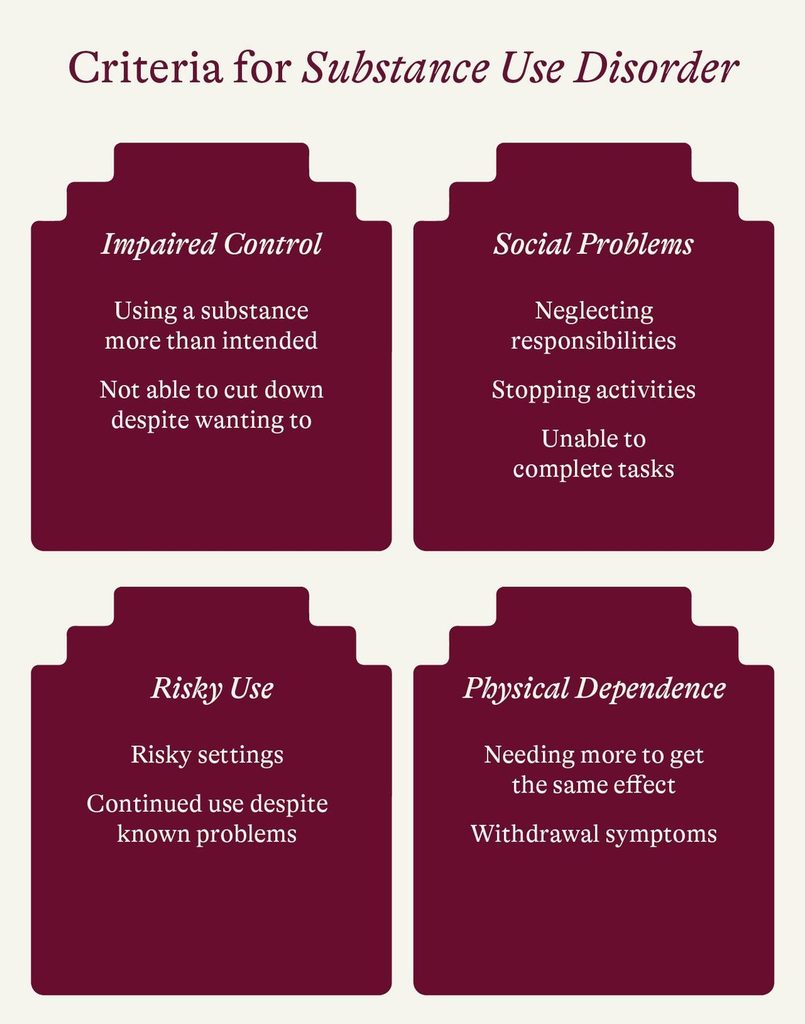
There are eleven criteria for substance use disorders that fall into four categories:
- Impaired Control (using a substance more than intended, not able to cut down or stop despite wanting to)
- Social Problems (neglecting responsibilities, stopping activities, unable to complete tasks)
- Risky Use (risky settings, continued use despite known problems)
- Physical Dependence (needing more to get the same effect, withdrawal symptoms)
Most importantly, dependence or addiction to substances alters the chemistry of the brain and functionally changes the brain circuits involved in A physical, mental, or emotional factor that causes bodily or mental tension. (APA), the reward system and self-control.
What does this all mean when we apply it to the use of phones?
Each of the four categories of substance addiction have overlaps with what we typically consider “phone addiction”. And while data on phone use varies, one 2023 study covers all of these in simple stats.
Impaired control:
The study shows that 75% of Americans feel uneasy leaving their phone at home and 47% feel a sense of panic or An emotion characterized by feelings of tension, worried thoughts, and physical changes like increased blood pressure. (APA) when their phone battery goes below 20%.
Social problems:
The study shows that 46% of people use or look at their phone while on a date and 69% have texted someone in the same room as them.
Risky use:
The study shows that 27% of people use or look at their phone while driving and 60% sleep with their phone at night.
Physical dependence:
The study shows that 89% of Americans check their phone within the first ten minutes of waking up and 75% check their phones within five minutes of receiving a notification. And in the event of a house fire or other major disaster, 82% would take their phone with them before evacuating.
And what about the chemistry of the brain that gets altered with addiction?
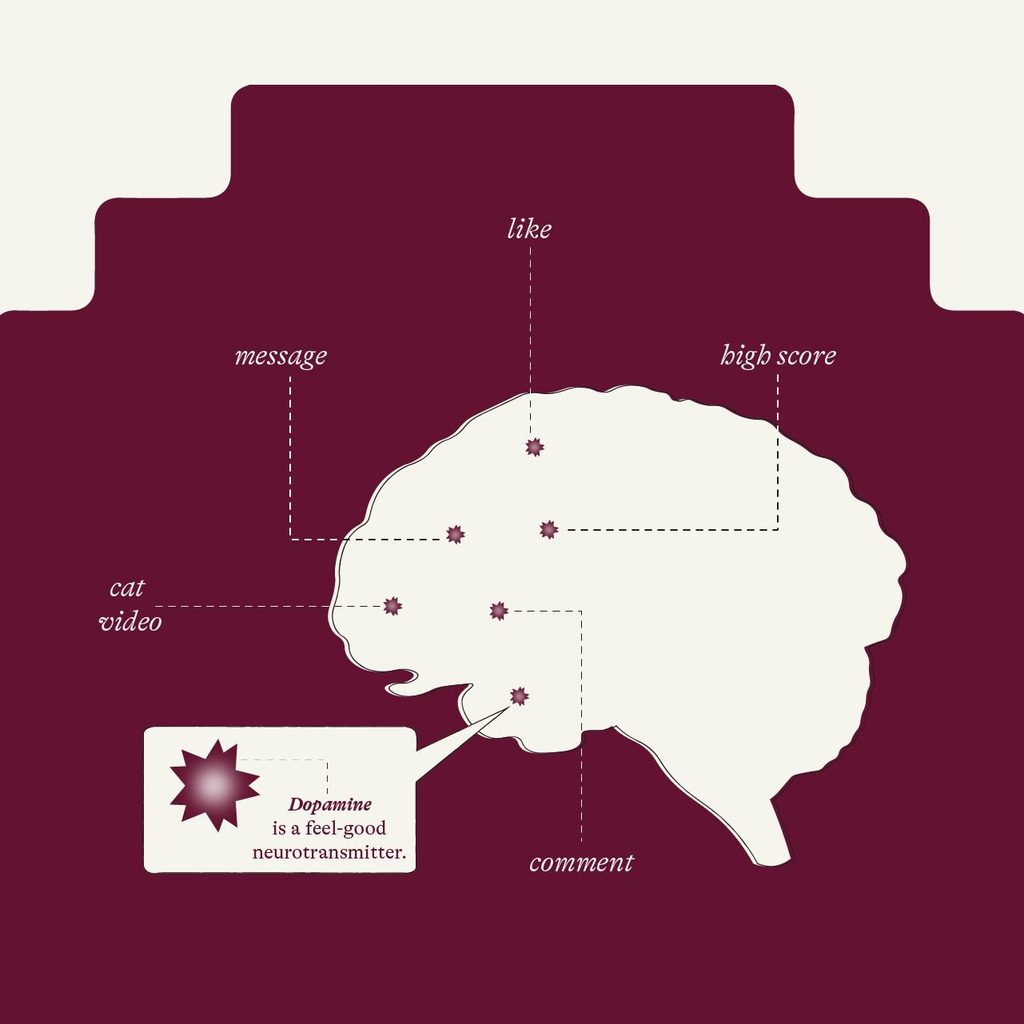
It’s certainly not the black rectangle in your hand that causes the addiction – but rather the content on it. As technology has advanced, app developers and content creators have tapped into the science behind dopamine to make content engaging and keep users coming back for more. Notifications, “likes” and platforms that encourage a user to keep scrolling tap into the brain’s dopamine and encourage more use.
The science of addiction has also brought us extensive knowledge on the science of quitting. This is undoubtedly a very complex issue that is dependent on each person’s addiction, life experiences and environment. But there are several key components that most experts include when working with people experiencing addiction.
These include:
- Set a goal. For most, quitting “cold turkey” is not a sustainable method. But goals such as, “I will be done drinking by my birthday” or smaller goals like, “I’ll limit myself to one drink today” are more achievable.
- Remove temptations from the environment. This can mean getting rid of the addictive substance, deleting the stored credit card on file, or otherwise making the addiction one step more difficult to indulge.
- Replace the addiction with something else. It is not enough to simply quit – the brain and body need to have an alternate activity to distract from the addiction. This activity should ideally replace the need for the original activity, so taking a walk instead of using a substance to de-stress or meeting up with a friend for coffee instead of going to a bar.
Note: This is an oversimplification of a complex process that is best done with a professional trained in addiction. These are listed as just some of the components of a full addiction recovery plan.
These same components can be a resource in helping navigate phone addiction. Let’s see how we can take these addiction lessons learned and apply them to our phone addictions.
Given that it can be nearly impossible to give up our phones entirely, since they have so many practical and necessary uses, these strategies can work to help us curb the addiction and have a healthier relationship with our devices.
Consider these tips:
Set a goal.
Work to identify a long-term goal or a series of smaller goals. A broad goal such as “stop using my phone so much” is likely to be ineffective. Instead, consider something like:
- Don’t use my phone while I am eating.
- Charge my phone in a different room from where I sleep.
- Reduce my screen time by 10% using the tracking metrics on my phone
- Have one hour of screen-free time every evening
Remove temptations from the environment.
Pay attention to the aspect of the phone that seems to cause the biggest challenge. Maybe it’s a social media app that you can’t stop scrolling through. Maybe it’s the constant notifications of a group text. Maybe it’s a game that you can’t stop because it will break your streak. Whatever seems to keep you most hooked on your phone or cause you the most stress or anxiety, identify a way to limit it. This might mean turning off notifications, muting certain conversations or deleting apps entirely. There are also features built into the phone that will disable apps after a set amount of time.
Replace the addiction with something else.
A big part of phone usage is that it’s something to do that keeps us entertained when we’re bored, exhausted, have had a long day, or don’t feel like doing anything else. Because we’ve become so accustomed to pulling out our phone any time we have an idle moment, we haven’t had as much practice sitting around and doing nothing. This means that we’re probably not going to have great success just trying to stop using our phones during these times. Instead, we need to fill that void with something else. Try picking up one of the magazines in the doctor’s office lobby, read a book before bed or find a hobby that uses your hands that can be done while sitting on the couch.
We don’t necessarily need an entry in the DSM-5 to validate what many are already experiencing – that for many, the reliance on phones has gotten out of hand. And while the nature of technology means that this conversation will always be changing, we can learn a lot from the decades of research that have already been done on addiction in general. But as they say in addiction, the first step is owning that you may have a problem. And when we are aware that our use of phones is not where we want it to be, that can be the start of a journey to a healthy relationship with our devices.
Technology and Parenting
Another concern about being so attached to our phones is that sometimes, we forget to pay attention to what’s happening around us. This is true of more than just our phones; technology has created a constant distraction in everyday life. This is something parent educator Alma Villarreal thinks we should be mindful of, especially when we are parents or caregivers who serve as an example to the children in our lives. Here are her suggestions on navigating this challenge.
Technology is great! It’s made life so much easier, right? You can ask Siri and Google just about anything. It helps us stay connected with friends and family around the world, and it constantly entertains us. It’s changed the way we shop, and bank and it has replaced cameras and, sadly, even books. It’s also made our work life a lot easier – with the ability to read and answer emails, make conference calls and stay connected around the clock.
So what’s the problem? The problem is this: Yes, technology is awesome! And we all enjoy talking on the phone, facetime, social media and watching YouTube videos. However, as parents it can also rob us of precious time with our kids – being in the moment – being present. Technology is not going anywhere; it’s only going to get bigger. But, if you think about it, what is going away is our kids’ childhood. It will pass us by with the blink of an eye. And once it’s gone, it’s gone forever.
Being mindful of all of this can be a good start to making changes in order to be present, truly present.
Here’s a few suggestions:
1. When you are with your kids, be with them.
Checking and replying to an email at your son’s baseball game can cause you to miss out on his homerun. And then that moment is gone. This is true for any other great moment and milestone. It can be easily missed while you’re busy posting about your day, or uploading the pictures you just took.
2. Make family rules and follow them
Rules such as “no electronics at the dinner table” or “no electronics in bed” are very important. It’s important to have family time where you’re actually looking face to face instead of staring at screens. If you set the rule, you also have to follow the rule.
As a side note, teens can make very bad choices after hours, so I encourage you to make a rule about appropriate times to put away their cell phone at night, or have a central charging station in your bedroom.
Remember that all rules have to have reasonable consequences. For example, if a child chose not to put up her phone until 9:30 pm instead of 9:00 pm, they will now lose 30 minutes of cell phone use the next day.
3. Be transparent
If you really must take a phone call or tend to an important email or business matter while you are spending time with your kids, it’s a good idea to say out loud, “Listen, I have to take this important call from my bank, but we will continue reading this book once I’m done”.
4. Be respectful to your kids on social media.
Be mindful of the pictures you are posting of them that are personal or private. Many times we can create anxiety and lose their trust when we do this. I’ve heard kids as young as 4 years old say things like, “Mommy, please don’t post this picture!” Think about it – you’d be mortified if your parents had the ability to do this to you!
5. Lead by example.
Remember that children are constantly learning from observing you! Parents often get annoyed with their kids because the kids are spending too much time with their electronics (video games, ipads and cell phones), yet many parents can’t seem to put their own phone down around their kids.
6. Don’t lose the ability to have a conversation.
This means talking not texting. As easy, convenient and nice as it is to send a text – and even a group text to your family, “Dinner starts in 15 minutes!” – we are also losing the opportunity to talk and connect with them. Let your kids know that it’s important for them to answer the phone when you call them, and not reply with a text.
I know we all have the best of intentions with our kids, and we never mean to prioritize our phones over our kids, but we’ve all let it happen from time to time. The important thing is to be aware of how often we’re looking at a screen and how well we’re connecting with our children in their presence. Connecting with kids can be so simple that it might not seem like much. But here are a few easy ways that parents can build that person-to-person connection.
Make eye contact. Get down to your child’s level. Use your body language to let them know that you are present and that they have your full attention.
Use touch. A simple rub of the shoulder, running your finger through their hair, holding their hand or giving them a hug lets her know that you’re with them.
Learn to listen. Really, truly listen. Not just nod in agreement while also thinking about all of the work emails you have to respond to. This takes practice! But by being intentional about it and really focusing your efforts on truly listening to your child, you can send a powerful message that you care about them enough to hear what they have to say to you.
Even on the busiest of days, try to make it a priority to spend at least three minutes a day playing with your kids. Three minutes really doesn’t sound like much, but it’s so important to do this. It helps improve the parent child relationship, builds trust, confidence and helps with brain development.
Think of age appropriate activities, keeping in mind that interest will vary depending on your child and your lifestyle. Try reading, art (painting, coloring, making bracelets), board games, playing dress up or painting your child’s nails (this is a good one as you are touching, looking at their eyes, and it provides opportunities to talk), playing sports as a family, spending time outdoors, have a picnic at the park. Even if it’s a quick sandwich, fruit snack or a box of pizza, the important thing is that you are connecting and spending time with your kids.
If for just three minutes a day, you put your phone away, look in your child’s eyes and have a conversation with them, you will be sending powerful messages that they matter. Of course, the more time you can spend, and the more often you can turn away from your electronics the better! Technology is great – and it’s made our lives so much easier – but nothing can replace the human connection between a parent and child.
Now let’s look at how technology affects our children at different ages.
Toddlers & Technology
Ever wondered if your child is having too much screen-time? In this video, we answer all of your questions about how much screen time is okay for toddlers and how much is too much.
Your Kid Wants a Cell Phone. Now What?
You’ve gotten through the early years of childhood and now the time has come. Your child is asking for her own cell phone. What do you do next? Dena Kohleriter, LCSW Licensed Clinician weighs in.
I would like to alternately title this post: Cell Phones: The Blessing and The Curse. Because in my experience in working with teens and families, that’s exactly what cell phones are. They can be a huge blessing – parents can contact their child and know where they are in those couple of free hours after school. They can help kids connect with their friends and they can be a huge lesson in responsibility and maturity. But of course, they can be a curse as well.
The biggest mistake that parents make when buying their child his first cell phone is handing it over without any discussion or guidelines. The first thing to keep in mind when your child starts asking for his own phone is that a phone should never be a gift. A phone should always be a loan.
You can explain to your child that you own their cell phone. Because they have proven themselves responsible and mature enough to use a phone, you are happy to loan it to them. But they must remember that it is a loan, which means it comes with terms. And if those terms are broken, well, it’s your phone. And you can take it back. (Of course, you should give them the opportunity to earn it back. We’ll revisit this in a minute.)
So because it’s your phone, you have the right to see everything on it. You will have passwords to all of the accounts that they access on the phone. You’ll be able to read anything on it at any time. Let them know that any texts they receive on their phone are copied to your phone as well. (You should tell them that you do this, or that you can do this at any time, even if you don’t set up this feature.)
Another really important rule to set in place with a child is that they have the right to borrow the phone between certain hours. At 9:00pm, the phone goes with you where it is charged in your room. The child can have the phone back beginning at an established time in the morning. The phone should also be off-limits at other pre-established times, such as the dinner table, or while watching movies as a family. And once they’re old enough, definitely no phone while driving.
It is important to teach your child about safe and unsafe phone behavior. Let them know that it is never okay to send or receive naked pictures on the phone. If the child ever receives a naked picture, they should let you know immediately and not try to hide it.
What happens when a child breaches the terms? This should be set in advance as well. The phone should be taken away if they break the terms of the agreement. But it should be for a specified amount of time (a day, or a week). Then you can explain that this is an exercise in continuing to build trust and responsibility, and that you’d like to give them another chance to make responsible choices.
I encourage you to have your child sign a cell phone contract. Here is a great one I found online. Of course you can create your own. As a family, you can identify the rules that you want to enforce and the consequences when the rules are broken.
Kids are tricky – they might try to make you feel like you’re oppressing them. That you’re intentionally making them suffer, that they’re missing out on everything their friends are doing after 9pm, that all of the other kids have cell phones and they’re poor victims of horrible parents. But you’ve got to hold strong. Remind them that having a cell phone is a privilege, not a right. And that your job is to keep them safe and give them freedom, while also protecting them and helping them make smart choices. Cell phones are a stepping stone to other technology.If they can learn appropriate behavior early on with a cell phone, they’re better prepared as they dive into social media and whatever crazy app we haven’t even heard of yet. It is imperative that we teach our kids appropriate technology use, and that begins as early as they have access to it.
I know none of us want to hear this, particularly those of us who are attached to our phones, but we also have to be careful about our phone usage in front of our kids. As they reach the age where they start having access to technology, we have to model good behavior. That means no texting and driving. If we ask our kids to put phones away at the dinner table, we have to, too.
Lastly, let me share some important apps and features that you may want to consider as your child gets their first cell phone. You should let them know that you’ve installed these and plan to use them.
- Ignore No More: this app can shut down a phone’s ability to do anything other than return a parent’s call or call 911.
- MyMobileWatchdog.com: You can use this to monitor your child’s phone activity and location
It is important to explain that these apps are not about snooping or oppressing your child. They’re about working together to keep them safe in the crazy world of technology. And in the end, this whole process is about keeping communication open as they face experiences that are new and unfamiliar to them.
Your Brain on Tech: A Free Workbook for Teens
We all know the cell phone is only the beginning when it comes to our children and their relationships with technology. That’s why we’ve created this free workbook designed to educate your teens on what happens in the brain when they use technology.
Have you ever told a teen to put their phone down only to be met with an eye roll or a look of disdain? Adults tell teens to do a lot of things, often without giving a reason. Sometimes, there isn’t a reason other than: “Because I said so”, but when it comes to putting down the phone, that isn’t the case.
There are a few things that happen in the brain when we use our phones that make it necessary that we develop healthy habits around phone usage. The Your Brain on Tech workbook combines information and activities to explain to teens what happens in the brain when they use their phones. The workbook highlights information about dopamine, the reward system and stress responses. It also includes several activities that allow teens to process the information they are learning and reflect on how they use their devices.
3 Ways Social Interactions Help the Brain that AI Can’t Replicate
The brain is a social organ wired to connect with others. It rewards us for social interactions that play an important role in shaping how we learn, feel and grow. Here are three ways that socializing helps the brain in ways that AI can’t replicate.
The Social Brain & Neuroplasticity
Spending time with other people isn’t just fun, it also supports our brain development and mental health. When we socialize, we activate the part of the brain that helps us with emotional processing, called the medial prefrontal cortex (mPFC). The mPFC lights up when we notice people’s facial expressions, tone of voice and body language. All the things that help us understand what others are thinking and feeling. And the more we engage socially, the more we strengthen our brain’s neuroplasticity, allowing it to change and adapt. This can boost our cognitive skills and help with emotional regulation.
Mirror Neurons & The ability to understand and share the feelings of another. (APA) Development
Have you ever noticed how yawns are contagious? Or have you smiled when you saw someone else smiling? That’s thanks to a group of brain cells called mirror neurons. These are activated when we witness other people’s behavior. That includes everything from facial expressions, gestures, speech patterns and even a self-contained phenomenal experience. Feelings are subjective, evaluative, and independent of the sensations, thoughts, or images evoking them. They are inevitably evaluated as pleasant or unpleasant, but they can have more specific intrapsychic qualities, so that, for example, the affective tone of fear is experienced as different from that of anger. The core characteristic that differentiates feelings from cognitive, sensory, or perceptual intrapsychic experiences is the link of affect to appraisal. Feelings differ from emotions in being purely mental, whereas emotions are designed to engage with the world. any experienced sensation, particularly a tactile or temperature sensation (e.g., pain, coldness). (APA). This is how we naturally learn empathy, and it happens through face-to-face interactions, where we are able to see and experience someone else’s feelings as our own. Interacting with AI doesn’t trigger these mirror neurons in the same way because it doesn’t feel or respond the way a human does.
Release of Feel-Good Chemicals
Warm, caring interactions with another human being, like a hug, smile or comforting voice, trigger our brains to release feel-good chemicals like dopamine and oxytocin. This happens when we help a friend or spend time with loved ones, and they don’t just feel good in the moment. The positive vibes we get from these experiences can actually build lasting connections and memories in our brains, and that encourages us to repeat this positive behavior in the future.
Engaging in social interactions is essential for our overall wellbeing. While AI might be able to simulate a conversation, it can’t create the same rewarding brain activity that comes from genuine human connection.
Click here to learn more and access our free download.
What You Need to Know about Brain Pruning and AI
Teens today are interacting with AI in many ways, some intentional and some as a product of the apps and websites they’re already visiting. Some teens are use AI chatbots as a sounding board, engaging in conversation and asking for advice. This leaves many adults wondering whether this is safe, and what it may be doing to their development.
Spending more time chatting with AI than with people could change the way our brains develop. If kids turn to AI to navigate life’s difficult moments, they miss out on the opportunity to strengthen important social skills, which could hinder their emotional growth. This is because of how interacting with AI affects a process our brains go through called synaptic pruning. What is Pruning?
At birth, our brains have almost all of the neurons they will ever have. Through time and experience, children’s brains develop millions of synaptic connections, and this changes the brain by increasing its density. But if a connection isn’t used, or if it becomes irrelevant in our daily lives, it gets cut out. This pruning process is especially active from late childhood to early adolescence.
It’s like our brains go through a renovation where certain underused areas get shut down. We keep the connections we use the most and get rid of the ones we don’t. It helps the brain stay efficient and reduces the amount of unnecessary information. This process is designed to sharpen our thinking, social skills and decision-making as we develop into adults. But what if, instead, our brains start pruning out the connections that help us gain these skills?
How AI Affects Brain Pruning
Think about a garden. Pruning helps it thrive. Now imagine if you didn’t just prune the weeds in your garden, but your flowers, too. You’d be cutting out the parts of the garden that you want to keep. When kids start using AI to perform tasks that require problem-solving and critical thinking, or they spend more time chatting with a bot than with their friends, they could be increasing brain pruning in the same way. The emerging concern is that neglecting to practice these skills at a time when the brain is weeding things out could potentially lead to the loss of neural connections.
These connections are essential to helping us understand how others are thinking or feeling by reading their facial expressions and body language. They strengthen our social awareness and empathy. When we prune these skills out, it can cause us to experience things like anxiety and A mood disorder that involves extreme sadness or despair and lasts longer than a few days. (APA), and it can weaken our ability to solve problems or connect with others.
The good news is, these skills can still be developed throughout our lives thanks to the power of neuroplasticity, our brain’s ability to change in response to experience. With effort and repetition, relearning these skills is possible, but our brain’s overall plasticity declines with age. That’s why it’s so important for us to be mindful of the potential connection between AI use and synaptic pruning as kids continue to incorporate AI more and more into their daily lives.
AI can be a tool for inspiration or gathering information, but it isn’t a substitute for interacting with other people. During the important pruning years of adolescence, kids need real-world experiences to help build the connections in the brain that allow us to solve problems and understand others. Every potential challenge, conversation or interaction is a chance to strengthen these connections that help us thrive as adults.
Click here to access this free download!
More Resources about Digital Wellness and AI
AI is everywhere, and it doesn’t appear to be slowing down anytime soon. Here are some resources to support you as you navigate digital wellness in the age of AI.
AI Safety Tips for Parents
Download this quick sheet for safety tips to protect your child’s emotional and mental wellbeing while using AI tools.
AI Reflection Questions for Kids
Is a child in your life turning to AI for advice, answers or support? Download this quick, free guide with reflection questions that can support how they engage with this technology.
5 Ways to Form Connections with People in an AI World
AI chat bots can be a helpful tool for advice, but they can’t replace a real human relationship. Here are five ways kids can form connections with others beyond the screen.
Free Download
Self Regulation Toolkit
Learn More Practical Tools to Help Children
Understand their Feelings,
Regulate Their Bodies and Manage
Impulses.