
Article • Apr 01, 2019
How Our Own Attachment Style Impacts Our Relationships
How are adult relationships impacted by our childhood attachment style? Read on to learn more.
What is Attachment?
What if we told you that we already know one of the most powerful and well-researched foundations for a child’s long-term social, emotional and mental health? Well, guess what. We do. It’s called attachment.
Attachment is the basic framework for understanding human connection. That is, how well a person is connected to others. Early connections establish a pattern for later connections in life. That’s why our earliest connections, the connections between a baby and their caretakers/parents/adults, are so important. What does this all look like?
Psychologist Mary Ainsworth identified three major types of attachment through her research: secure attachment, ambivalent-insecure attachment, and avoidant-insecure attachment. In later research, Main and Solomon added a fourth attachment style called disorganized-insecure attachment. Let’s take a look at these four styles of attachment.
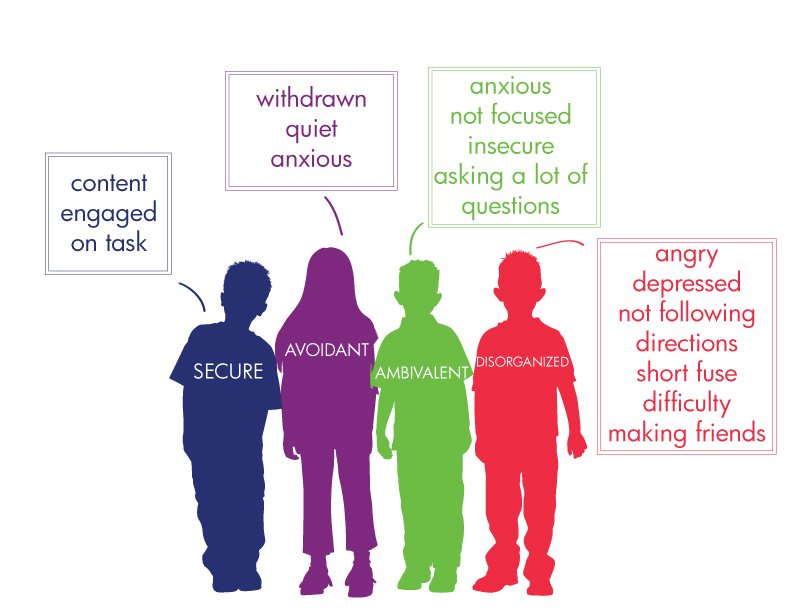
Secure Attachment
A child with secure attachment has, you guessed it, a sense of security in the world. This child has parents who consistently meet her needs. They know that they are cared for and loved. If they cry, a parent will come. If they’re hungry, they will be fed. If a parent leaves, they will return.
It’s really important to mention that no parent gets this right 100% of the time. In fact, research demonstrates that this perfect connection is not possible, and even the most loving, highly attuned caregivers are “getting it right” between 30-50% of the time. That’s a relief, right? The key differentiator is parents who make every effort to repair any emotional damage or infractions, through an apology and a sincere effort to do better when things don’t go well. So it’s okay to mess up, but it’s important to repair. Parents and caretakers who are attuned to their child and show security and love can develop a secure attachment.
Anxious (or Ambivalent) Insecure Attachment
On the opposite end of the spectrum is what is commonly referred to as insecure attachment. Ambivalent-Insecure Attachment occurs when a parent is inconsistent in caring for the needs of the child. For example, this might be a parent who takes care of a crying baby one time, but the next time they cry, the parent ignores them. This is confusing for a young child or baby. They are now left wondering in their internal world, “If I cry, will someone take care of me?” or “Sometimes dad loves me, and sometimes he doesn’t.” As a result, being raised with this type of attachment can cause a child to act disinterested or ambivalent toward the caretaker as a way to mask the distress they might feel when they are confused or left alone. This ambivalence can keep the child from forming strong, positive emotional connections with their caretaker. Children with Ambivalent-Insecure Attachment are often highly anxious.
Avoidant Insecure Attachment
Children who develop Avoidant-Insecure Attachment often have their needs minimized or not responded to at all. This might look like a parent responding to a crying child with, “You’re fine. Get up. Stop whining like a baby.” It might be a child showing their mom something they made at school, and mom telling them to leave her alone because she’s too busy. This dismissive style of parenting is damaging to young children who rely on their parents for not only physical needs, but also emotional needs. A child growing up in this environment might interpret this response as devaluing them as a person and might not continue to try connecting emotionally with other people. Children with Avoidant-Insecure Attachment can turn inward. They are often the quiet children who fly under the radar.
Disorganized-Insecure Attachment
This is truly the most damaging of the three insecure attachment styles, and is a result of highly unpredictable parenting. Children with a Disorganized-Insecure Attachment style often live with a parent who is terrified, terrifying or both. If a child is crying, a parent might yell, “Why are you crying?!” Sometimes a parent may minimize behavior and other times might blow up about a child’s behavior. Children who live in homes with domestic violence often have a disorganized attachment – children in this situation are often afraid to be at home. Unfortunately, with no intervention, children who have this type of attachment style can face lifelong negative consequences. Children with Disorganized-Insecure Attachment are often the “out of control” kids. They have a hard time self-regulating and turn their pain outwards – towards others.
But there’s good news, too! All it takes is a secure attachment with one caring adult to make the difference in a child’s life. So if a child grows up in a home with an insecure attachment to their caretaker, they can form a secure attachment with a grandparent, teacher, neighbor, family friend, or other, caring, trustworthy adult.
A solid understanding of attachment can help those who work with children better understand where the child is coming from and why they behave the way they do. This perspective can help adults understand the powerful impact of relationships on helping children develop.
What Parents Should Know About Attachment
We know that attachment is a significant factor in how well a child will do in life. However, attachment theory has only been around since the early 1970s, and as with any theory, it has taken many years of research for us to fully understand how attachment affects children and adults. This means that the majority of adults today were not raised by parents with a strong understanding of attachment styles.
There are four different attachment styles: secure attachment, ambivalent-insecure attachment, avoidant-insecure attachment and disorganized-insecure attachment. Secure attachment is the goal. A child with secure attachment has parents who consistently meet their needs and feel secure in the world.
The attachment styles a child experiences from a young age affect how their brain is wired. Attachment in childhood wires our brains to know whether someone is going to show up for us and keep us safe. This shapes how we understand relationships later in life. Everyone has patterns of attachment, and we can each have multiple patterns. It is important to understand this because patterns of attachment can become trans-generational. Let’s take a look at how this can work.
Growing up, Sarah’s parents weren’t able to help her manage strong emotions, leaving her on her own to deal with them. Her brain wired itself to deal with emotions by essentially ignoring them.
Sarah had a son named Brandon. Because Sarah had to deal with her emotions on her own during childhood, she didn’t know how to help her son manage his emotions as a child. As with his mother, Brandon’s brain wired itself to dismiss and avoid his emotions.
Sarah and Brandon’s story is an example of how patterns of attachment can become trans-generational. Individuals can only use the tools they have at their disposal. The good news is that once we become aware of this, we can consciously develop the tools we currently don’t have. Let’s take a look at how Brandon did this when he became a parent.
When Brandon became a parent to his daughter Iliana, he noticed that when she would experience strong emotions, he didn’t know how to help her. He had always felt uncomfortable dealing with emotions, but once he saw his daughter struggling with her emotions, he wanted to help, but felt unable to do so.
After doing some research and discussing the situation with his partner, Brandon learned about attachment styles and how they can wire someone’s brain to respond in a certain way. He engaged in self-reflection and realized that his responses were because of the pattern of attachment he experienced when he was a child. Knowing this, he began to develop skills and tools so he could show up for his daughter and help her feel secure when she experienced strong emotions.
Just like Brandon, we all have the ability to provide our children with a pattern of secure attachment. However, to do so, sometimes we have to do a lot of self-reflecting and digging into our own past. When we understand how we were parented and how our own brains have been wired towards relationships, we are able to recognize patterns that we are repeating and break them. This process allows us to increase our capacity to see and respond to our children’s needs.
Reflecting can be hard. Digging around in your past and thinking about your emotions is not easy and often draining. However, it can also be healing. It can not only help you show up for your children the way that you want to, but it can help you develop a sense of compassion for yourself and empathy for the parents or caregivers who raised you.
So, how do you get started?
First, make a commitment that you are going to do your best to show up for your child and make them feel secure. Dr. Tina Payne Bryson and Dr. Dan Siegel coined the 4 S’s in their book The Power of Showing Up. The 4 S’s are: Safe, Seen, Soothed and Secure.
When you are unsure if you are showing up for your child the way you need to in any given moment, take a second to ask yourself the following:
Am I making my child feel safe?
Does my child feel seen?
Am I soothing my child?
Does my child feel secure?
Sometimes, showing up for your child can be simply saying, “You’re safe. I’m here, and we’ll figure this out.”
Second, make a commitment to yourself to do the work. About 40% of the population does not have a secure attachment with their parents. Remember, everyone can have multiple patterns of attachment. So, chances are, doing the work and self-reflecting will help you develop some tools that you may not have right now.
This work can be done in different ways. You can reference books such as “The Power of Showing Up” or listen to our podcast episode with Dr. Tina Payne Bryson on attachment. Or, you can seek help from a professional therapist to guide you through this process.
Having a secure attachment with your child does not mean that you are showing up perfectly; it means that you are showing up predictably. No one is perfect, but we don’t have to be. So make a commitment to explore your own attachment styles and to show up consistently and predictably for your children. In doing so, you’ll be setting them up on a lifelong (and multi-generational) path to wellbeing and success.
When Attachment Is Distrupted
A child’s attachment to his parents and/or caregivers shapes how he’ll relate to the world, how he’ll learn, and what kind of relationships he’ll form. However, there are plenty of circumstances that disrupt a secure attachment. It could be the loss of a parent, a child with multiple caregivers, illness, substance abuse, domestic violence, and the list goes on. If the attachment is disrupted, the child may not develop the secure base needed to form and support relationships throughout life.
We know that a secure attachment is best for children, but what happens when they don’t have that? What does that look like for children, and how can we, as adults who work with children, care for and connect with these kids?
Let’s start by talking about these children with attachment disturbance. It is common for children in this situation to project an image that isn’t accurate. They might come across as self-sufficient while hiding feelings of insecurity, or they might be exceedingly charming but are buried in self-doubt. Kids with attachment disturbances often exhibit more extreme behaviors that might include, but are certainly not limited to, poor eye contact, poor impulse control, stealing, lying, and acting out. If we don’t take time to dig a little deeper, these kids might be what is often labeled as the “troubled” or “bad” kids.
But we want to help these kids and dig deeper, so here are some tips for connecting with kids who have attachment disruption. The most important thing is this: Relationships are the key. A safe, predictable environment helps all children, especially those who don’t have that environment at home. Children who have insecure attachments often don’t know what to expect, and they live in an unpredictable world. They need to know what’s coming. This means letting children know the schedule and when things will change. It means showing up every day with a calm demeanor, and not fluctuating back and forth in how children are treated and talked to. It means showing up even after a child has acted out, and not walking away when it gets harder.
Children with insecure attachments might try to “push buttons” to get a reaction out of an adult. Sometimes to adults, this looks like disruptive behavior or comes across as manipulation. But when a child is used to an adult responding with anger, abuse, neglect, or simply leaving when a child acts out, the child is likely using his behavior to test how an adult will respond. If a teacher or other adult responds consistently with a calm response, the behavior will eventually fade as the child learns to trust the adult. Adults need to model healthy ways of relating to kids. When adults send the message, “You can act out, but I am not going anywhere,” children learn to see the world in a different way. If this is new to a child, it may take time. Remember that a new connection is being formed in the child’s brain. It won’t happen overnight, but with time, the brain can rewire to make sense of this new attachment.
Now let’s look at a few ways we can engage with kids who have an attachment disturbance:
Praise
Praising a child out of the blue is a great way to build a secure relationship with a child. It shows the child that the adult is paying attention and valuing their contributions. It can be as simple as, “I noticed you were making great choices today. Thank you for being here!”
Provide Choices
A lot of behavior is about the child seeking control in a life that doesn’t provide much control. With that in mind, letting the child feel they have choices can help. Adults can be deliberate about using the word “choice” as often as possible. For example:
“You are making the choice to continue to play after I have asked you to clean up.”
“You made a great choice by lining up quietly like I asked you to.”
“You didn’t make the best choice when you threw that block, but we can try again tomorrow to make a better choice.”
Adults can also provide children with two equally viable choices. For example, a child may not be able to choose whether to do a math lesson or go to recess, but they can choose between stations during free time, which outfit to wear to school that day, or which book to read. As long as both choices are acceptable, letting them choose helps provide them with a small sense of control over their day.
Statements not Questions
Have you ever asked a child who is acting out, “Why did you do that?” Did you get a perfectly logical response, or did you get a shoulder shrug? Most often, kids don’t know why they misbehave. When they’re reacting from their amygdala, the emotional part of the brain, their prefrontal cortex, which is the reasoning part of the brain, essentially goes offline temporarily.
So instead of asking a dysregulated child why they’re doing something or whether they remember the rules, adults can use statements. For example, “Nick, did you cut in line at the water fountain?” can be rephrased to, “I saw that you cut in line at the water fountain. I’m going to need you to line up last when it’s time to go.”
That child may be upset at the consequence, but this way at least he can’t protest the reasoning as it is based on evidence and logic instead of emotion.
Pay Attention
Of course when working with a large group of kids this can be difficult, but it is important for adults to be observant about a child’s nonverbal behaviors, facial expressions, tone of voice, etc. This will tell more about what’s going on with a child than his words will. Providing small opportunities to check in with children, such as greeting each child at the door in the morning, can help dial into these unspoken behaviors.
Ultimately there are two ways to look at misbehavior. There’s the idea that kids are out to get us, that they’re intentionally being disruptive, that they are acting out because they dislike us, or any other reaction that has more to do with adults than the children themselves. And there’s a second way of looking at misbehavior, which is that it serves a purpose. Children are sending us messages through their behaviors. Children with attachment disturbance are trying to connect with adults in a way that makes sense for their survival. If they’re not used to predictable, secure relationships with adults, they’ll need extra support to enter into one and maintain it. The great news is that it’s never too late for a child to form a secure attachment, and it doesn’t have to be with a parent or primary caregiver. That’s reassuring for those of us who work with these kiddos. We just have to remember to be patient, pay attention, be consistent, and stick with them even when it’s hard.
How Our Own Attachment Style Impacts Our Relationships
We’ve spent some time focused on the importance of attachment in children. However, these early experiences matter because they affect us long term. They can shape multiple facets of our lives, including the relationships we form and the parents we become. Let’s take a look at the four attachment styles again, and see what they can look like in adults.
Secure Attachment
This is what we all hope for. If a child grows up with a secure attachment, they understand healthy relationships. They are secure, grounded and expect relationships in life that are reliable. They can trust people. They can also consider and hold other people’s emotions for them. What this translates to is an adult who can tolerate difficulties in a relationship and utilize healthy coping skills to manage these challenges. By virtue of expecting others to be trustworthy and reliable, people with secure attachments tend to actually foster this in their relationships. Therefore, a child who grew up in an environment with a secure attachment will, not surprisingly, be more likely to form solid, healthy adult romantic relationships and friendships, and more likely and capable of raising their own children with a secure attachment.
Ambivalent-Insecure Attachment
As you may recall, this attachment style is more common in children whose parents were inconsistent – sometimes present (both emotionally and physically), and sometimes not. These children often present as highly anxious. As adults, children who grew up with this attachment style may be overly attuned to their partner. Trusting others is difficult, and therefore, they may become hyper-aware of the other person and overly focused on small details. For example, they may wonder what the other person is thinking, or why he hasn’t called all day, or where he is at any particular moment. It can be harder for someone who was raised with this attachment style to trust and believe that loved ones will follow through or stick around. As you can imagine, this type of behavior can push other people away. For adults with an ambivalent attachment style, this pulling away is often met with attempts to pull loved ones back. The difficulty arises when the same behaviors that pushed someone away (e.g., doubts, insecurities, questioning) are the ones used to pull them back in. Two people who share this attachment style in a relationship are often chaotic together, fluctuating between close and distant, struggling to trust each other, and believing the other should “just know” what they need without asking.
Avoidant-Insecure
This attachment style often develops when a child’s parents were consistently absent or dismissive. As a result, these children begin to see the world as a place where others cannot be relied on and where their emotional needs often go unmet. As adults, this can manifest as fear of closeness or intimacy. These individuals are often afraid to get too close to others for fear of being hurt – understandably, they feel an innate need to protect themselves. And if your childhood experiences teach you to focus on and take care of yourself, it can be hard as an adult to be attuned to others and instinctively notice when others need support. This can appear to others as selfish or aloof, when in reality it may be a fear of the vulnerability that comes with putting one’s own needs aside to help someone else. Vulnerability is difficult for everyone, but more so for people whose vulnerability has historically been met with disappointment or hurt. In romantic relationships, people with this attachment style might pull away from a partner during times of difficulty, or might struggle to get close at all. As parents, they may struggle to understand and connect with their children in an attuned and intimate way.
Disorganized-Insecure
As we know from studying attachment, disorganized-insecure is the most harmful of the attachment styles. This tends to result when caregivers are inconsistent; vacillating from caring behaviors to those which are frightening or terrifying. Unfortunately, children who grow up in this type of environment often struggle with relationships throughout life. Their relationships may be characterized by a desire to be close while at the same time pushing others away. In the most extreme cases, relationships among adults with this attachment style can involve physical or psychological violence. Adults who grew up in such a disorganized home often struggle to understand their ability to self-regulate and ultimately look to others to fill that need. In a disorganized attachment environment, children don’t learn what healthy, reasonable parenting and nurturing looks like. So, as a result, they’re often unable to provide this type of relationship to their own children when they become parents. A parent who was raised in a disorganized attachment home might not understand why a child needs her, and might not have the context of what it feels like to be nurtured, nor how to provide that to others
Now, the difficulty that comes when we have such categories is that few of us fit squarely in just one. Most of us have complex histories and find that we take on parts of each, or lean toward one but have tendencies that align with others as well. These kinds of generalizations are not made to categorize or diagnose people. And this is not meant to justify or condone harmful behavior.
So why share this at all? Without awareness, there is little capacity to change. When we begin to understand why people do certain things, we can be proactive and do something about it. This may mean doing more of the same and helping our children develop the same strong skills we have. For others, it may require self-reflection about our families of origin as well as our current relationships.
We often hear that we parent the way we were parented. And to some extent, this is true. But – a huge, important note is – we don’t have to. As we strengthen our self-awareness, we strengthen our capacity to be more intentional in our relationships and in how we parent our children.
So, when we react strongly to something, we can ask ourselves, “Am I reacting to what’s happening in this moment, or am I instinctively slipping into patterns from my past?” When we are stressed, we are more likely to revert to a less functional style of parenting, especially when our default is based on an insecure style of attachment.
We highly recommend the book “Parenting from the Inside Out” by Dr. Dan Siegel and Mary Hartzell. It dives deeper into many of these and other topics for those who want to explore this further.
The good news for adults is similar to that which we emphasize for children. Our relationships with others can heal us, and we can provide what we need from each other. If you recognize insecure attachment styles in yourself or your family and are having relationship difficulties, asking for professional help can be an important and brave step toward the changes you want.
Can Our Attachment Style Change?
Our earliest relationships help shape the way we connect and share our emotions with others. But does that mean we’re stuck in those patterns of attachment for life? Can our attachment style change?
How Early Relationships Shape Attachment
When children experience big emotions, they don’t always know how to calm themselves down. They learn how to do this from their primary caregivers through co-regulation.
Think of a baby crying because they’re hungry. Their caregiver recognizes that need and responds by scooping them up and feeding them. This helps the baby move from distress to a calmer, more regulated state. That’s co-regulation. Over time, this helps build a sense of safety and security. Children learn that it’s okay to express their emotions and that someone will be there to help hold those emotions with them, leading to secure attachment.
On the other hand, if the adults in a child’s life struggle with emotions or aren’t equipped to hold those big feelings with their child, the child may learn to keep those emotions inside rather than share them. This can contribute to insecure attachment. These early experiences inform our attachment styles, influencing how we interact with other people and whether or not we feel comfortable expressing our emotions with them.
The good news is, we don’t necessarily have the same attachment style across every relationship. We can form a secure attachment with one caregiver and an insecure attachment with the other. On top of that, while our early experiences do influence how we approach the relationships in our lives, as we have new experiences and connect with people who make us feel safe and supported, this can help us develop secure attachment.
What is Earned Secure Attachment?
Throughout our lives, we can have new experiences that help us become more emotionally secure. Each time we express our feelings and receive support from someone in return, it’s a chance to build our capacity for deeper connections.
Imagine you had a difficult day at work. Instead of keeping your feelings inside, you call a friend. You tell them you’re not okay. They listen and offer support. Suddenly, you realize that it’s okay to share when things are hard, and there are people who will be there for you.
These interactions show us how sharing our emotions, even when they are big or scary or difficult, can actually bring us close to others rather than pushing them away. Noticing how we respond to strong emotions, practicing sharing our feelings with people we trust and allowing ourselves to be supported all contribute to earned secure attachment.
Each experience builds on the last, helping us form deeper connections with the people in our lives. Our earliest relationships are formative, but our early attachment isn’t necessarily our destiny.
More resources