
Resource • Nov 20, 2026
Breathing Exercises for Kids: Simple Techniques for Calm and Focus
Why We Should Teach Kids About Breathing
Breathing is something that we do all day, every day. We walk around without even noticing that we’re doing it most of the time (except maybe after we climbed that flight of stairs after lunch). But being more aware of our breathing, and particularly helping children become more aware, is an incredibly powerful tool.
There is a huge amount of research available about the positive effects of The practice of being aware and present in the moment, and accepting one's feelings, thoughts, and bodily sensations without judgment. (APA). At the core of mindfulness practice is mindful awareness, beginning with breathing. When we teach children how to control their breathing, we give them the ability to focus and control their reactions to any situation.
When our breath is shallow and rapid, it can trigger the release of A physical, mental, or emotional factor that causes bodily or mental tension. (APA) hormones (the fight, flight or freeze response that we’re all familiar with). When our breath is slow, deep and measured, it signals our body to release hormones associated with calm and centered well-being. Research is showing that breath control is especially helpful for people with special challenges like ADHD, chronic pain, and a history of An emotional response to an event that is perceived as harmful or threatening, and that has lasting negative effects on a person's physical, mental, social, emotional, or spiritual well-being. (APA), to name a few.
There are many ways to focus on breathing. As you introduce a child to mindful breathing, you might want to ease into it. You can’t expect a child to sit quietly and breathe for several minutes on the first try. Be realistic about your expectations. It will help to introduce the idea to the child so they are on board. Here’s a sample of what you might say:
“Did you know that you do something all the time and you don’t even realize it? Can you guess what it is? Breathing! Did you know that you can use breathing to help you pay attention and even feel better when you are feeling strong emotions? Let’s play around with our breathing a little bit and see what we notice.”
Then you might guide children to take some long, deep breaths vs. some quick, shallow breaths and let them reflect on how they feel.
Over time, you might introduce some new breathing strategies. We’ve shared a few below to get you started. Remember, there’s no one right strategy. Most people love some and dislike others. Work with your child until you find something that they like. Don’t be afraid to mix it up, or to build on a strategy. Maybe you start and stop with a chime to indicate breathing time, and then a week later, you increase the time between the chimes. Or maybe you start with breathing, and then add in some body movement.
The point of mindful breathing is to calm and center the child, allowing them to focus on their body for a moment. A wonderful side effect is that they’ll learn they can control their breathing and use it to calm themselves down during a moment of An emotion characterized by feelings of tension, worried thoughts, and physical changes like increased blood pressure. (APA) or stress. And the great side effect for you? A child who does a mindful breathing activity will be calmer, more relaxed, more focused, and ready to learn. And isn’t that the dream?
Ready to get started? Here are some of the breathing strategies for kids that we love the most!
Breathing Exercises for Kids
Bunny Breath
The idea of Bunny Breath comes from Yoga Pretzels, a book of yoga poses for kids and adults. We’ve taken the idea and turned it into a breathing activity you can do with an individual or a group of children. This is a great tool when you need a group to clear their minds or become more alert, such as during a transition period in your classroom or that after-lunch comatose phase.
Have the children sit tall on their shins with their backs straight, like a bunny. Tell them that they’re pretending to be a bunny sniffing the air for other bunnies, or for carrots to eat. Model taking three quick sniffs in the nose and one long exhale out the nose. Repeat several times: sniff, sniff, sniff, b-r-e-a-t-h-e.
Giving kids the opportunity to notice the difference between long and short breaths is important. If a kid can identify when they’re experiencing short breaths and understand how to slow their breath down on their own, they can be better prepared for those inevitable high-anxiety situations. Of course, what kid doesn’t love pretending to be an animal? Bunny breath is a fun, useful activity for the kids in your life. Give it a shot!
Hoberman Sphere
One of our favorite tools for teaching kids about breathing is the Hoberman Sphere. This is a classic toy that you can buy online or at most toy stores. We’ve found it incredibly helpful in teaching kids about their breath.
When kids get excited or worked up, their breath gets shorter and faster. There are two important things to note about this:
1) Asking a worked-up child to calm down and take deep breaths often causes more anxiety. We’ve all seen it happen – a child is short of breath and crying, and you ask them to breathe. They start taking even shorter, more anxious breaths. Focusing on their breath can actually make it worse!
2) When a child is in a state of anxiety, it is completely normal for the adult’s anxiety to also increase. It’s stressful to be around an upset child!
This is why the Hoberman Sphere is such a great tool. Using a prop, the child can externalize their anxiety. This shifts the focus of breathing to something outside themselves, which can be calming. Here’s how to use it:
“Let’s take a minute to use this sphere to focus on our breathing. I’m going to match the sphere to the speed of your breathing.”
Expand and release the sphere slightly at a speed that matches the child’s breathing. As the child inhales, expand the sphere. As the child exhales, contract the sphere. Then let the child know that you’re both going to slow down your breathing together. Ask them to try to match their breath to the speed of the sphere. As the adult, it’s important that you also slow your breathing. Children pick up on this, and if you’re slowing down, they will too. Then you will both be in a more centered, regulated space to talk about what caused the original upset.
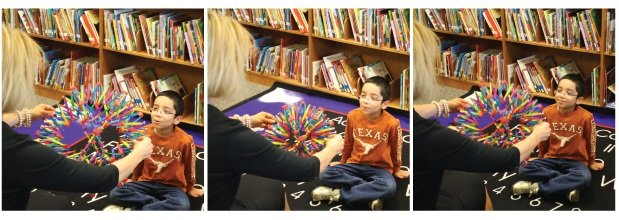
Once the child is more regulated, ask questions about the experience. Which type of breathing was easier? Was it hard to slow down your breathing? What type of breathing do you do most of the time? What type of breathing makes your body feel most relaxed?
This is a great tool for helping a child calm down, but it can also build the skill of mindful breathing. Try it with an individual or group of kids during a calm time. Giving kids the tools they need to go from fast to slow breathing is invaluable—they’ll be better equipped to do it on their own next time!
The Pinwheel
When kids are learning about breathing[JT1] , props really help. It’s one thing to ask a child to take a deep breath, but something else entirely when they can see the difference between a short, shallow breath and a long, deep breath. So here’s a really simple strategy using a prop that you can easily pick up at any dollar store or toy store.
Ask a child to blow as hard as they can on the pinwheel. Look how fast it spins! Kids love to start off with a big breath—that’s really easy and fun. You might build this section out a little. Is that the fastest you can make it? Do you want to try again and see if it can go even faster?
After they’ve exhausted the full breath, see if they can slow it down. What is the slowest and lightest you can breathe and still move the pinwheel?
Then check in with the child. You can ask them questions such as:
- Which type of breathing was easier?
- Which did you like the best?
- Which is most like how you usually breathe?
Giving children insight into their breathing allows them to notice it throughout the day. A prop like the pinwheel can help them stop and visualize their breathing. The next time you notice a child struggling, you might draw attention to their breath.
Ask curious questions: “What is your breath like now? I wonder if taking some slow, deep breaths might help you feel better?”
At a moment of anxiety, the child might think, “I’m breathing crazy fast.” Now they’ll have a strategy to slow their breathing down.
Belly Breathing
We call this simple strategy belly breathing. (We can thank our friend Susan Kaiser Greenland, author of The Mindful Child[JT2] , for this and many other strategies.) Many of us breathe from our chest, shallowly. To benefit from the calming effects of breathing, it’s important to know what it feels like to breathe from your belly.
To teach kids belly breathing, have them lie down on the floor. Place an object that has some weight to it on his belly. We like to use a small stuffed animal. But you can use any object at all: a building block, a notebook, a toy.
Instruct the child to watch the object move up and down on their belly. As they take longer breaths, tell them to notice what happens to the object. For an older kid, you might encourage them to visualize the object riding the waves as they breathe.
It’s pretty simple. But sometimes it’s those tiny tricks that change how we think about breathing and help kids really grasp the concept.
Starfish Breathing
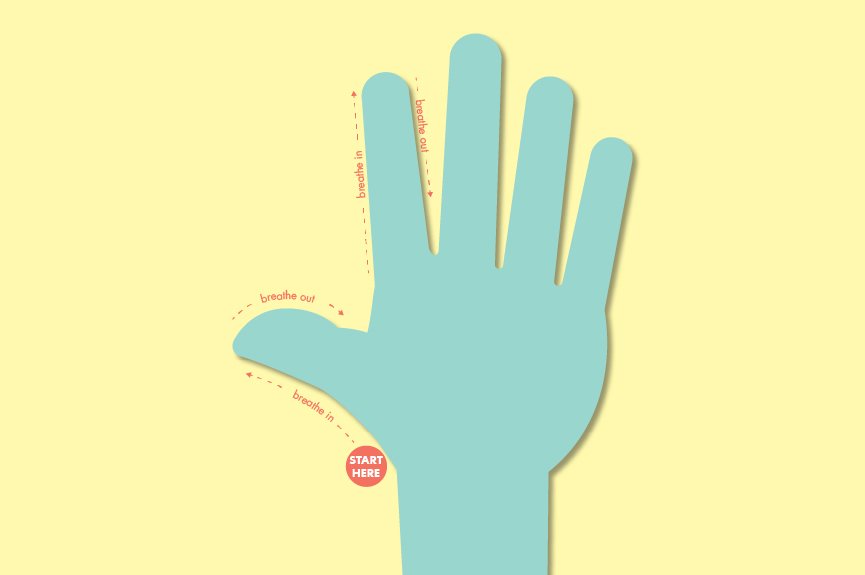
This is a quick breathing strategy that can easily be done anywhere: starfish breathing! Hold your hand up and begin to trace your fingers, starting with your thumb. As your finger moves up the finger, have students breathe in, and as it moves down the finger, breathe out. Slowly trace your thumb up (breathe in), and down (breathe out), then move to the pointer finger. As you finish tracing your fingers, you will have done five deep, slow breaths in and out in the shape of your hand (or, to make it more fun for kids, in the shape of a starfish!)
Box Breathing
You may be familiar with the concept of “box breathing”. In this method of mindful breathing, you can trace a box with your fingers. As you trace, you breathe in for four seconds along one side of the box, hold your breath for four seconds, breathe out for four seconds, and then hold for four seconds.
Many people use an imaginary box in the air, but you can also use a box on a sheet of paper, the outline of a square object, a box made of tape on the wall, or any other box. This is a quick, simple breathing practice that students can do from home.
Lemon Breathing
We’ve made downloadable resources [JT3] for you to use this simple breathing strategy as a The ability to manage one’s emotions, thoughts, and behaviors in different situations. (APA) tool.
Simply use your finger to trace along the dotted lines, breathing in and out slowly. Repeat three (or more!) times to help regulate your The organ located in the head that controls thoughts, memory, emotions, touch, motor skills, vision, breathing, temperature, and every process that regulates the body. (APA) and body.
Bonus! Join the challenge to practice lemon breathing every day. Color in one piece of the lemon for every day you complete the lemon breathing until the lemon is completely filled in.
Breathing Check-in
We have been sharing stories and ideas with you about how to help children identify and control their breathing. But have you thought about your breathing lately? Sometimes as adults, it’s easy to forget to practice what we preach. So let’s take a minute to check in on our own breathing, shall we?
- Do you feel your breathing in your belly or your chest?
- Are you breathing fast or slow?
- Can you make each breath last a little bit longer?
- Can you feel your belly move with that breath?
- Can you feel the air going in through your nose?
Pssst… these questions will work with kids too! If we establish breathing routines, a child will feel comfortable accessing the breath any time they need it, including during times of stress.
And let’s not forget that we need to be aware of our own breathing in order to best help children. Some people have found that setting a chime to ring on their phone at intervals throughout the day is an easy way to remember to pause and check in on their breathing.
We The belief that the future will be better than the present and one has the power to make it so. (APA) this little check-in leaves you feeling just a little more relaxed and ready to take on the rest of the day.
Breathing Strategy Videos
Want to see more breathing exercises in action? Check out our bank of videos here.
Free Download
Self Regulation Toolkit
Learn More Practical Tools to Help Children
Understand their a self-contained phenomenal experience. Feelings are subjective, evaluative, and independent of the sensations, thoughts, or images evoking them. They are inevitably evaluated as pleasant or unpleasant, but they can have more specific intrapsychic qualities, so that, for example, the affective tone of fear is experienced as different from that of anger. The core characteristic that differentiates feelings from cognitive, sensory, or perceptual intrapsychic experiences is the link of affect to appraisal. Feelings differ from emotions in being purely mental, whereas emotions are designed to engage with the world.
any experienced sensation, particularly a tactile or temperature sensation (e.g., pain, coldness).
(APA),
Regulate Their Bodies and Manage
Impulses.